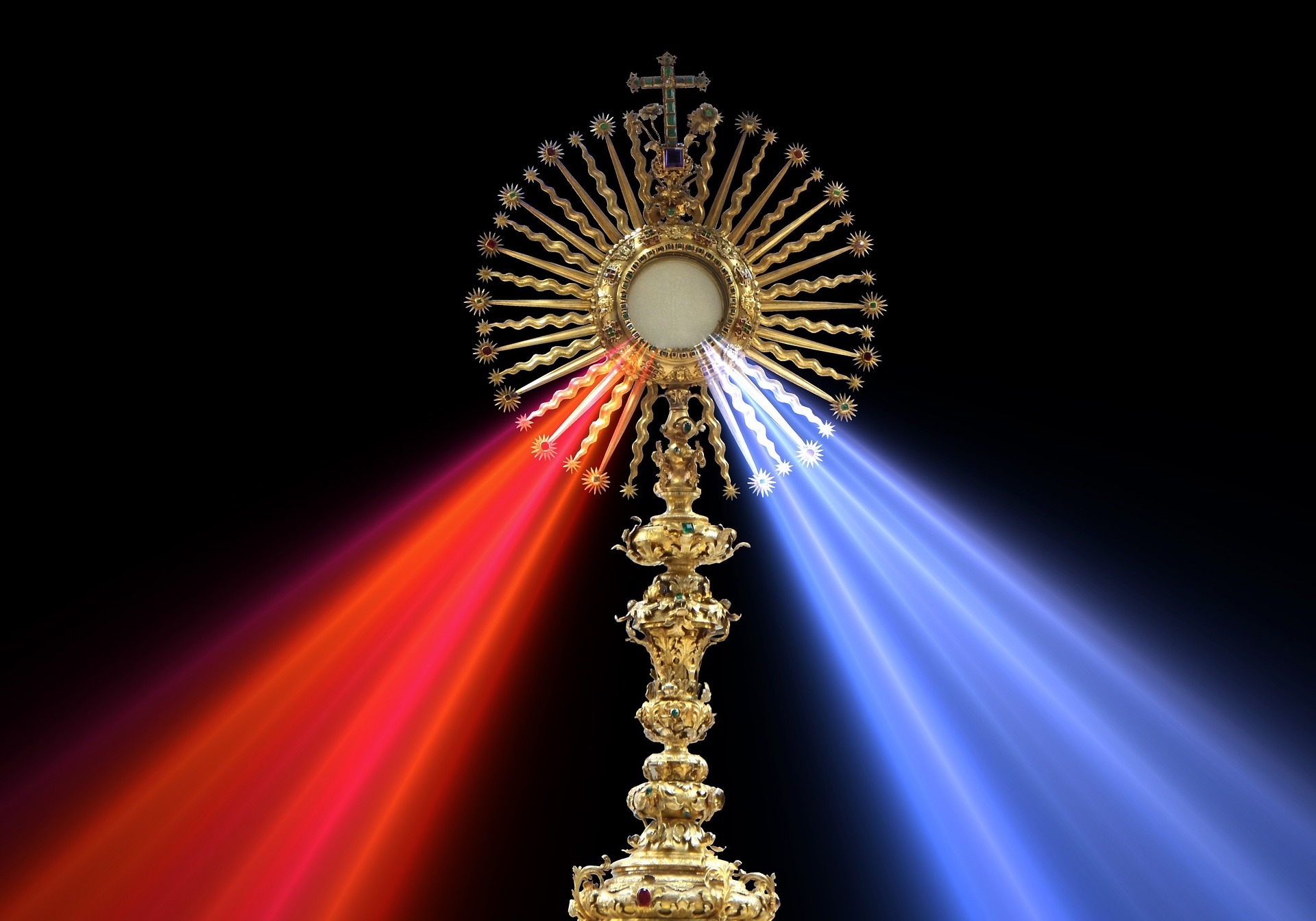
Reflection for Divine Mercy Sunday 2026

By Deacon Richard Hay

In the 1930s, in a quiet convent outside Kraków, a young nun named St. Faustina Kowalska began receiving extraordinary visits from Jesus. She wasn’t a theologian. She wasn’t well known. She wasn’t someone the world would have chosen.

And yet, Jesus entrusted her with a message meant for every soul on earth. A message that would echo across decades, continents, and cultures.

He revealed to her His Heart as a fountain of mercy, a place where the greatest sinners would find the greatest welcome. He told her, “Let no soul fear to draw near to Me, even though its sins be as scarlet.” He asked her to write, to pray, to intercede — and to help the world rediscover something we often forget: that God’s deepest desire is not to condemn, but to heal.

Then He gave her an image — Jesus stepping toward us, hand raised in blessing, rays of mercy flowing from His Heart — with the simple, powerful words: “Jesus, I trust in You.”

This devotion exists because Jesus wanted the world to know that His mercy is not abstract. It is not distant. It is not reserved for the holy or the strong.

It is for the broken, the weary, the ashamed, the searching — for every one of us.

And the Gospels show us exactly what that mercy looks like when it takes flesh.

The Prodigal Son — Mercy That Runs Before We Speak

Picture the younger son on that long walk home — dusty, rehearsing excuses, unsure if he’ll even be allowed through the gate. He expects judgment. He expects distance. But the father has been watching the road.

And when he sees that familiar silhouette, he ‘runs’ — something no dignified man in that culture would do. He hikes up his robes, exposes his legs, and sprints toward his child.

  • He doesn’t wait for the apology. 
  • He doesn’t measure the sincerity. 
  • He simply embraces him.

Mercy becomes a robe, a ring, sandals — and a feast.  Mercy moves first.

The Woman Caught in Adultery — Mercy That Stands Between Us and Our Accusers

Imagine her terror: dragged into the public square, surrounded by stones and accusations. Her sin is real — but so is her fear.

  • Jesus bends down.
  • He refuses to join the spectacle. 
  • He refuses to look at her with condemnation. 
  • He refuses to let her be defined by the worst moment of her life.

Then He stands — not beside her, but between her and the crowd. “Let the one among you who is without sin be the first to throw a stone.”

One by one, the stones fall. And then He turns to her: “Has no one condemned you?” 

“No one, sir.” 

“Neither do I condemn you.”

Before He calls her to conversion, He restores her dignity.

Peter — Mercy That Turns Failure Into Mission

Peter’s failure was loud and public.  He denied Jesus at the very moment Jesus needed him most.

And yet, on the shore of the Sea of Galilee, the Risen Jesus doesn’t ask, “Why did you fail?”

He asks, “Do you love me?”

Three times — one for each denial — not to shame Peter, but to heal him. 

And then He entrusts him with the Church: 

“Feed my sheep.”

Mercy doesn’t erase our past. It transforms it into a place where grace speaks louder than failure.

Matthew — Mercy That Sees What We Can Become

Matthew is sitting at his tax collector’s booth — a place of compromise and sin – most people avoid him.

Jesus walks straight toward him.

  • He doesn’t demand a moral résumé. 
  • He doesn’t wait for Matthew to clean up his life. 
  • He simply says:  “Follow me.”

And something long buried in Matthew awakens. 

  • He stands. 
  • He leaves the booth. 
  • He becomes a saint.

Mercy is God seeing more in us than we see in ourselves — and calling it forth.

The Paralytic — Mercy That Heals the Wounds No One Sees

His friends lower him through the roof — a dramatic act of faith. Everyone expects a physical miracle.

Jesus begins with something deeper: 

“Your sins are forgiven.”

  • Before He heals the body, He heals the heart. 
  • Before restoring movement, He restores identity.

Mercy reaches the places no one else can see — the places where fear, guilt, or regret quietly immobilize us.

Five Stories, One Heart

  • Five people. 
  • Five different forms of brokenness.

And in every one of them, Jesus moves toward the person, not away. He steps into shame, fear, failure, sin, and paralysis — and brings peace, restoration, and new life.

This is the heart of Divine Mercy:

  • There is no story God cannot rewrite. 
  • No sin He cannot forgive. 
  • No wound He cannot heal. 
  • No distance He cannot cross.

Placing Ourselves in the Story

As we gaze upon the image Jesus asked St. Faustina to share — Jesus stepping toward us, hand raised in blessing, rays of mercy flowing from His Heart — we are invited to place ourselves in these Gospel stories.

  • Maybe today you feel like the prodigal, unsure if you deserve to come home. 
  • Maybe like the woman caught in adultery, carrying shame you hope no one sees. 
  • Maybe like Peter, disappointed in yourself. 
  • Maybe like Matthew, stuck in patterns you don’t know how to break. 
  • Maybe like the paralytic, unable to move forward.

Wherever you find yourself, the message is the same:

Jesus comes to you. 

  • He steps into your story. 
  • He brings mercy that restores, heals, and sends you forth renewed.

So, as we continue this service, we pray the words that echo through this devotion, the words that have carried countless souls back to the Heart of Christ:

“Jesus, I trust in You.”

Divine Mercy Sunday Reflection

By Deacon Richard Hay

When I was asked to give this reflection, I initially thought I might approach it much like a homily that would be given on Sunday. However, after praying about it, I felt called to share and reflect on how mercy has impacted my life.

Mercy is an interesting thing because, at least for me, I didn’t recognize some of these mercies when they were happening – it was only afterwards that I came to understand the mercies received and how they led to other mercies.

In the last year, I believe that I have received more than my own share of God’s mercy – most particularly around everything with Margo’s diagnosis and death last year, my ordination, and the months since as I have served as a deacon here at Sacred Heart.

In hindsight, I can even look over the three final years of my formation in the permanent diaconate and now see the mercy and grace God gave Margo and I individually and as a couple – in our faith – to build up mercies that we would need to sustain us later.

At the time, we of course did not know what the future held for us but looking back now – with the eyes of faith – I can see those instances of mercy we were graced with in preparation for the final two months of Margo’s life and the way we approached her diagnosis and prognosis – praying for a miracle each and everyday but acknowledging that God’s will be done.

Of course, until her diagnosis, we were approaching life with the expectation that I would be ordained and serve as a deacon somewhere in this diocese. So, the mercies we were encountering were welcomed but we felt they were preparing us for that expectation – life as a permanent deacon alongside of his wife.

However, all things are in God’s time and in His will – so these mercies were and are part of His greater plan – a plan He has for each one of us – we just have to be paying attention at some point.

The mercies I want to focus on for this reflection are those which we received in and through prayer.

For years, Margo and I had tried to start praying together more than just at meals or when a situation occurred that prompted us to pray.

Even those would be very quick acknowledgements of the prayer needed as opposed to intentional prayer being offered. Attending Mass together as we did was also a form of prayer but not what we were trying to do over the years.

As formation for the permanent diaconate began in the fall of 2018, we aspirants were told that we should begin praying the Liturgy of the Hours – specifically Morning and Evening Prayer – because those two hours would be an obligation on our part following ordination. We were also encouraged to do it as a couple if possible.

I began that fall and Margo started joining me for Evening Prayer at the beginning of 2019. Spending that time together, praying the prayer of our universal church, was a mercy in so many ways.

By the way, if you want to understand about having mercy for someone else, try learning how to navigate the pages and ribbons of the Liturgy of the Hours. This was indeed something that required mercy from each of us to be patient with the other as we learned. Those beginnings of sharing Evening Prayer together resulted in us choosing to convert one of our spare rooms into a dedicated prayer room. We also began praying a daily rosary together and other devotions including the Divine Mercy Chaplet after we learned more about St. Faustina at a mission held at St. Luke’s.

As we continued prayer together, we noticed that suddenly we were more likely to talk about scripture we heard at Mass, or something we read during prayer, or a faith related subject – conversations we had never really dived into before – and not superficial discussions. So now,  the mercies we received through prayer – specifically through our prayer together – our faith dialogue with each other was deepened and expanded.

The mercies we gained through prayer together also helped prepare us for when Margo suffered the debilitating cervical pain which she had from late 2021 until she had surgery and fusion of two sets of vertebrae in her neck in May of last year. During those months, that sometimes meant she was just present as I prayed Evening Prayer. It also shifted my role at home to caregiver more often. Margo received mercy to allow herself to be cared for as she was fiercely independent and I received mercy to be patient with her. It was easy for me to slip into selfishness though, but I was also blessed to receive mercy in the sacrament of reconciliation when I failed.

There was mercy received because I have a job that allowed me to be at Daily Mass before and after my ordination. That enabled me to take the Eucharist to Margo each and every day when she was basically homebound. Truly what ended up being food for her journey.

There was mercy when she finally had her cervical surgery last May and started to heal from the fusion and was able to be present when I took my vow of obedience to the bishop at our pre-ordination retreat mass.

There was mercy in the form of Bishop Estevez, whom I had just shared Margo’s terminal diagnosis with during our one-on-one meeting that same day. The mercy he shared with me and later with Margo was the shepherd caring for the sheep. He sat with Margo at dinner after that mass and they just chatted about living in Italy, going back and forth between Italian and English as they talked. Nothing about her diagnosis – just normality. That mercy filled my heart as I watched them.

Then there was the mercy of Margo being pain free three weeks after her cervical surgery and able to fully participate at my ordination. That was such a blessed weekend in so many ways.

My ordination was merciful in another way because now I was not only able to continue bringing her communion each day but I could now offer her my blessing as an ordained deacon in the morning when she woke up and another at night before she went to bed.

A week after my ordination, her oldest son came for a visit and they had a great week together – another merciful blessing.

It was not long after he left that Margo started to decline and eventually had to go into the hospice in-patient facility for her final days.

If you want to see mercy in action, the nurses, aides, and staff at the Hadlow Center are angels who walk on this earth in their vocation to care for others during the most vulnerable time in their lives.

For those last six days, God’s mercy was present each day around Margo and our family. From the friends and family who came to visit and say goodbye, the messages and calls which we shared with her, to those who stopped in to pray with us – we were surrounded by mercy – most especially in Margo’s final anointing – and our ability to be at her bedside in those final minutes – praying the rosary as she asked us to do.

After her death, while we were still in the presence of her earthly body, I received even more mercies as I was able to offer our church’s blessing and prayers for her mortal remains.

There have been so many mercies received and I could go on and on about them but let me close with this observation.

God’s divine mercy abounds – it is all around us and those mercies are unconditional – just like his love for us. They are present even when we might not recognize they are there but let me tell you from personal experience, if you are able to reflect about those experiences you will see them, feel them, and experience them – they can and will bless you beyond all measure.