Homily for the First Sunday of Lent (Cycle A)

By Deacon Richard Hay

“No shortcuts…”

Well, it has been around four days since this season of Lent has begun – how is everyone doing so far??

Don’t worry. It’s early and I suspect many of us are still getting things going and figuring out what it is we will work on – whether that means giving up some habit or maybe introducing something new in our spiritual and prayer life.

Here at the parish, we have some ready-made options for you like Stations of the Cross each Friday evening at 7 PM here in the main church, daily mass that can be added to your schedule during the week, our upcoming parish mission in March and our parish reconciliation service. Details are in your bulletins, so be sure to mark your calendars to take advantage of those opportunities.

You have often heard me talk about how our daily scripture readings lead us into the readings we hear at mass on Sunday. Well, I am here to share that once again in these four days since we received our ashes on Wednesday that continues.

The gospel on Ash Wednesday cautioned us against performing righteous deeds just so others could see them. Whether it is prayer, fasting or almsgiving, Jesus cautions that when that happens, we will have already received our reward – the adoration and recognition of others.

On Thursday, Jesus reminded us that He must suffer and be rejected which would result in his death but would be followed by his being raised up.  He also reminded us that we must deny ourselves and take up our cross to follow him.

Then, on Friday, Jesus reminded us that the day is coming when the bridegroom – Jesus himself – will be taken away from us.

In Saturday’s gospel, Jesus calls Matthew to be his disciple and that evening Matthew hosts a dinner for Jesus with tax collectors and sinners as guests. When challenged, Jesus tells them that the healthy do not need a physician but the sick do. Jesus did not come to call the righteous to repentance but sinners.

Each one of these gospels over these last four days are reminders to us of why we have this season of Lent in the church – to help draw us closer to Jesus through prayer, fasting, and almsgiving. They are also a reminder that Jesus is there for all of us no matter what – even though we are sinners.

Every year on this First Sunday of Lent, the church brings us into the desert with Jesus. Not because God wants us to feel bad about ourselves, but because He wants us to discover the joy that comes from being made clean and ready for all the good things he has in store for us.

Lent is a time for discipline, for confession, for honesty so that we can reach that refreshed state in our souls.

In today’s gospel, Jesus faces three temptations – each one is a shortcut. A shortcut away from the Father’s will. A shortcut away from the mission. A shortcut away from love. If we are honest, most of our temptations work the same way.

During the first temptation, Satan tells Jesus to turn stones into bread. In other words, to use His power to make life easier. To avoid discomfort – to take the shortcut. However, Jesus knew it was not the Father’s will to use His divine powers to spare himself the suffering of His human condition. Jesus refuses to take the easy way out.

We face this temptation too – the temptation to comfort, to instant gratification of whatever numbs or distracts us.

Lent gives us a response to this – fasting. Fasting trains our desires. It teaches us that we do not live by bread alone, and that our bodies don’t get the final say.

For the second temptation, Satan takes Jesus to the top of the temple in Jerusalem – not a random cliff or other high place – but the very spot where prayers rise up to God from the Jews praying in the temple. He challenges Jesus to prove himself and jump off the temple parapet so that the angels of God can catch Him.

However, that would have resulted in fame and celebrity for the sign, but Jesus’s mission was about humility and not sensation.

For us, this temptation is the desire to be noticed, to be admired, to be validated. It’s the temptation of social media – “Look at me. Approve of me. Tell me I matter.”

Jesus refuses to test God. He refuses to make his identity something that he must perform for.

Our Lenten discipline here is prayer. Not the kind that tries to impress God, but the kind that admits we need Him. Prayer acknowledges our need for God and submits to His will admitting that we can’t do any of this without Him.

The final temptation Jesus faces in today’s gospel is lust of the eyes. Satan, who has failed at his previous efforts to tempt Christ, shows Jesus every kingdom and power across the entire earth and gives a simple requirement – “Bow before me and it is all yours.”

Think about it, so much to gain through a small act of worship and wouldn’t Jesus be able to do great things for everyone in these earthly kingdoms?

The difference – this was not the Father’s will. Jesus understood that the Kingdom of God would only come through the cross – not through compromise.

For us – this is the temptation to possess, to accumulate, to control. Lent gives us a remedy for this as well – almsgiving. Almsgiving breaks the grip of greed. It frees our eyes from wanting everything we see.

Ultimately – Jesus’s victory over the devil is our victory. It helps us remain faithful when we are tested.

We don’t go into Lent to prove ourselves – we go into Lent to cling to Him who has already won. Our Lenten efforts are not effective on their own. They are only effective when we unite our small, token efforts with the work of Jesus. Without Jesus, nothing we do in Lent or at any other time of the year matters – that is the key.  

Prayer, fasting, and almsgiving don’t save us – Jesus saves us. Observing these disciplines, simply opens the door.

As I conclude – a short story.

A little girl told her mother, “For Lent, I’m giving up broccoli.” Her Mom replied and said, “But you don’t even like broccoli.” The girl grinned and said, “Exactly – this way it’s easy!”

We smile and laugh at this because we recognize ourselves. We all want a Lent that’s easy – but Jesus shows us a Lent that’s honest, courageous, and rooted in love.

Jesus didn’t take shortcuts – nor should we.

So here’s the invitation for the remainder of Lent:

  • Fast to discipline the desires of the flesh
  • Give alms to free your eyes from greed
  • Pray to humble your heart before God

Above all – unite every effort – big or small – to Jesus. When we do, Lent becomes more than a season…

  • It becomes a transformation
  • It becomes a share in His victory
  • It becomes the path that leads us to Easter joy.

Amen

Homily for the Fourth Sunday of Advent (Cycle A)

By Deacon Richard Hay

“Waiting with promise and trust…”

Looking back over the first three Sundays of Advent, we have heard a lot about preparing prayerfully as we wait for the arrival of Jesus at Christmas. The goal has been to not rush forward on the calendar but to use this period to prepare our hearts for His coming.

Yet – even here in our church – there has been the need to take care of some things during this final week of Advent as I am sure many of you had to do at home. Don’t worry – that is all OK.

As beautiful as it all looks – even more so when the lights are turned on – those things are still not our focus on this final Sunday of Advent. Instead – we shift our gaze on love – the love God has for us.

Did you know that during the seven days before Christmas, the church shifts to a particular set of prayers and scriptures for the daily mass to help us complete our Advent preparation.

First, we hear the genealogy of Christ in the Gospel of Matthew – all 42 generations.

We also heard the same gospel which I just proclaimed and how Joseph was told in a dream by the Angel of the Lord to take Mary into His home and not be afraid.

The next gospel tells of the angel Gabriels visit to Zechariah when he learned that his wife Elizabeth, who we know was Marys’ relative, would give birth despite her advanced years to a son to be named John. Zechariah was also made mute for his disbelief.

Next, we hear again from Luke about Gabriel’s visit to Mary for the Annunciation. Mary provides her yes to this news even though she did not fully understand it at that moment.

Next week before Christmas, we will continue to hear from this special series of gospels about Mary’s proclamation of the greatness of the Lord – her Magnificat – also known as the Canticle of Mary; then we will hear about the birth and naming of John. As he receives his ability to speak once again, Zechariah offers blessing to God in what we now know as the Canticle of Zechariah.

As you can see, scripture is beautiful and can not only help us prepare for the Nativity of the Lord in this case, but can also unite the readings as we come together each Sunday. If you do not already read the daily mass readings, it can really enrich your prayer life and the life we live in the church.

And now we find ourselves just four days away from Christmas. The final candle on our Advent wreath glows with anticipation. Outside, the world is bustling – stores are crowded, lists are long, traffic is hectic, and our calendars are full. But here, in this sacred space, we are invited once again to pause. To breathe. To listen for the gentle whisper of God’s presence among us.

Advent is a season of waiting, but it’s not a passive waiting. It’s a time of hope-filled expectation, of preparing our hearts to welcome Christ anew. And today, the scriptures speak to us of promise, of trust, and of the extraordinary ways God enters into our ordinary lives.

Our first reading from Isaiah takes us back to a moment of crisis for King Ahaz and the people of Judah. Surrounded by threats, filled with fear, Ahaz is offered a sign from God – a sign he is almost too afraid to accept. Yet God, in His faithfulness, gives the sign anyway: “The virgin shall conceive and bear a son, and shall name him Emmanuel.” Emmanuel which means God is with us. Not God above us, or God far away, but God right here, in the midst of our struggles, uncertainties and triumphs.

This prophecy is a promise for us, especially when we feel overwhelmed or anxious about the future. God’s answer to our fears is not always to remove the challenge, but to assure us of His presence within it.

Saint Paul, in his letter to the Romans, reminds us that God’s promises are not empty words. Jesus is the fulfillment of all that was foretold. Paul’s greeting extends God’s love to all people, no matter their background or burdens. In a world that often divides and excludes, Paul’s message is clear: God’s love is for everyone. No one is left out of the story of salvation.

Then we come to Joseph in the gospel. A figure who often stands quietly in the background of the Christmas story. Joseph’s world is turned upside down by news he cannot yet understand. He faces a choice: to walk away, or to trust in God’s mysterious plan. In a dream, the angel tells him, “Do not be afraid.” Joseph listens. He chooses trust over doubt, love over fear. He welcomes Mary and the child Jesus, embracing a future he cannot fully see.

How often do we find ourselves in Joseph’s shoes? Life brings unexpected turns – a diagnosis, a loss, a change we didn’t ask for. Like Joseph, we are invited to listen for God’s voice, to trust that even when we don’t have all the answers, God is at work.

When God enters our lives – they are no longer average and comfortable. Joseph and Mary remind us of this in the way God is incorporated into their lives and His plan of salvation. We then are invited – expected – to also be part of that – to trust his promise.

We step into God’s plan of salvation when we come to the Eucharist at Mass and receive the Body, Blood, Soul, and Divinity of Jesus in the Most Blessed Sacrament. Nourished with this gift that came at such a high cost, we must be ready to trust and let our lives go in a new direction.

We do this because He lives in us which means being Christian is not the “status quo” – and while we might not feel worthy of our role in His church, to be Christian and a member of the Body of Christ – we must do so boldly anyway.

In fact, the Psalm we heard today affirms our worthiness of this role.
When we hear that “only those with clean hands and pure hearts stand in God’s holy place” – it might seem that we who are flawed human beings are not included. However, the psalm also states that we can climb that holy mountain as long as we are among those “who desires not what is vain”.

Perhaps some of us are facing challenges this Advent – a family struggle, a loss, a worry about the future. The message of God is that He is with you, and you are not alone. Joseph’s example encourages us to respond with faith, to say “yes” to God’s invitation, even when it asks us to step out in courage in the face of the unknown.

These readings remind us that God’s presence is not reserved for perfect moments or perfect people. Emmanuel – God is with us – comes into the messiness of our lives – the uncertainties, the disappointments, the joys and sorrows. God is with us in the hospital room, at the kitchen table, in the quiet moments of worry or wonder. Like Joseph, we are invited to trust that God is working, even when we cannot see the whole picture.

The love we celebrate at Christmas is not just a feeling – it is a gift, given to be shared. Let us open our hearts to receive Christ anew in these final days of Advent. Then we can carry His love into our families, our workplaces, and our community as we prepare our hearts for the coming of Christ.

Homily for the Feast of the Dedication of the Lateran Basilica in Rome (November 2025)

By Deacon Richard Hay

“Prepare purposefully…”

Did you notice how quickly things shifted after Halloween? The moment that Friday ended, holiday commercials took over, and stores jumped straight into Christmas mode. It’s like there’s no pause—no chance to catch our breath before Thanksgiving. Everything just rushes ahead to Christmas.

And don’t get me started on Black Friday – what used to be a single day is now multiple days and weeks in length.

Now, don’t get me wrong—Christmas is a time of joy. It’s when we celebrate the birth of Jesus, our Savior, and that’s something we should never lose sight of. But while the world races from one holiday to the next, the church invites us to slow down, to move through the seasons with intention.

In a few weeks we will begin the Season of Advent, which will lead us to Christmas but in a much more reflective preparation compared to the rush of the secular world.

Just like the rush of holiday related advertising throws us forward on the calendar whether we want to or not, if we rush through these final days and weeks of the church year, we will miss the beauty of what the church has giving us, which helps us to understand that we must prepare for the end times in a measured and thoughtful way.

Although the month of November is not a formal season of the church year like Advent or Lent, it is a time where we have the opportunity to prepare our hearts and souls for the coming of the Lord and our encounter with him when our life in this world ends – when it is time for us to stand in front of the throne of judgement and give an account of our lives.

One way November helps us prepare for that is focusing our prayers on our family and friends who have passed from this life to the next. We pray very particularly for their souls and for the souls in purgatory. In praying for them we acknowledge that one day we will experience that change in our lives as well.

Through Sacred Scripture, over the course of this past week in the daily readings, a beautiful tapestry has been weaved leading up to this weekend’s liturgy. We have heard in these readings about how we should prepare for the end of our lives on this earth and being ready for that encounter with Christ.

On Monday, we were reminded that if we perform the corporal works of mercy we will be blessed because we did it for them even though they had no means to repay us – that we will be repaid at the resurrection of the righteous. If we act without fanfare, celebration or expectation of a return, then the Lord knows all that we do and will reward us.

On Tuesday we heard the parable of the man who was having a great dinner and those who were invited made excuses not to attend. He sent his servants out to invite the poor, crippled, blind, and lame instead and proclaimed that those who were invited before would not taste the dinner prepared for them because they did not accept the invitation. Don’t miss the opportunities to grow closer to the Lord.

On Wednesday Jesus said that anyone who comes to him without hating his father, mother, wife, children, brothers and sisters, and even his own life – cannot be his disciple. We heard that we must carry our own cross and renounce all our possessions to be his disciples. In other words, we must be willing to let go of our attachments in this world, such as relationships as we know them and our possessions, to be ready for the next life with God.

On Thursday we were reminded that we are the Lord’s whether we live or die and that each of us must eventually give an account of ourselves to God. We were also reminded that there will be rejoicing in heaven among the angels of God when the one who was lost repents and returns to the Lord. There is always hope in the Lord if we turn towards Him.

Then on Friday, we heard again the parable of the steward who squandered his master’s property. He was removed from his position but was praised for acting prudently in dealing with his master’s debtors to save himself in this life. It is a reminder that what we do in this world, must be done for the love of God and our neighbors – not for selfish reasons as that is contrary to what God asks of us in this life.

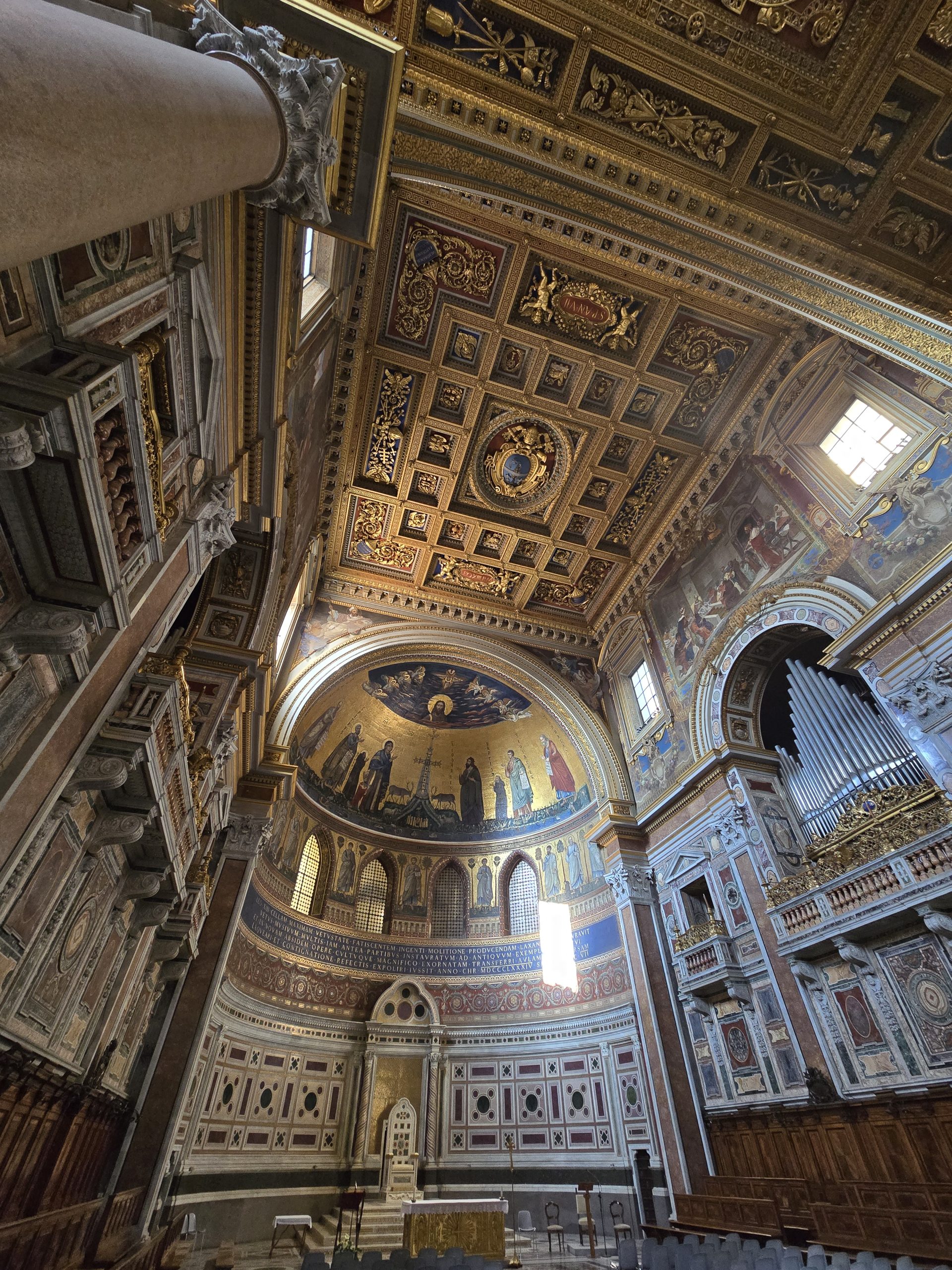
All of this leads us to this weekend’s Feast of the Dedication of the Lateran Basilica in Rome. A physical building that is the seat of the Bishop of Rome – our Holy Father Pope Leo XIV. Initially it might seem like an odd feast because it is for the dedication of a building. It is celebrated as a feast on our church calendar because it reminds us that the beauty of this world which we see in our churches and other places such as shrines and in nature, are a gift from God.

It is also a reminder that our bodies are temples of the Lord – that we are the church of God – built in His image. As St. Paul writes in our second reading, “Do you not know that you are the temple of God, and that the Spirit of God dwells in you? If anyone destroys God’s temple, God will destroy that person; for the temple of God, which you are, is holy.”

Keeping ourselves holy requires continuous effort just like physical buildings such as the Lateran Basilica in Rome and our church here in Fleming Island, require maintenance to remain sturdy, sound and beautiful. The church provides us with the means to maintain our own bodies and souls so they can remain sturdy, sound, and beautiful. Through Sacred Scripture, that weaves together a message to help us in this life, God gives us His inspired words because he loves us and desires us to be holy. The Sacraments given to us through Jesus, allow us to receive God’s graces to sustain us when this life is challenging and difficult. Then Sacred Tradition, given to us by the church herself, enriches our lives of faith these days with belief and understanding from across the more than 2,000 years of the church’s existence.

If we can make an effort to not succumb to the frantic pace of life in the secular world, to take our time in the seasons of the church to grow and deepen our love of God and his people, then we can be blessed in this life and be ready for the next when we finally get to encounter the God of all Creation, the God who makes us all that we are and gives us all that we need. Then we will be ready to hear him say to us, “Well done, good and faithful servant.”

Homily for Solemnity of All Saints – November 2025

By Deacon Richard Hay

“Holy Men and Women of God, pray for us…”

“I believe in the Holy Spirit, the holy Catholic Church, the communion of saints, the forgiveness of sins, the resurrection of the body, and life everlasting.”

Those words are from the final part of the Apostle’s Creed – a profession of faith in the early church. From this statement of faith, the Nicene Creed was developed to more fully state our believes as Catholics. This is the creed we profess together at the Sunday liturgy and on Solemnity’s like All Saints today.

I mention these words of the Apostles Creed because it states our belief in the “communion of saints” since the earliest days of the church. This theological concept refers to the spiritual unity of all members of our faith, those who have gone before us in death, those in purgatory, and those of us who are still living in this life, because we are all united together in Christ.

The perception of many outside of the Catholic church is that we “worship” the saints. However, that is not the case. Instead, we “venerate” the saints because, as the church teaches, the saints are alive in heaven – face to face with God – and can “intercede” for us with God concerning our prayer petitions.

Yes, we can of course pray directly to God as the first person of the Holy Trinity, we can pray directly to his Son, Jesus, as the second person of the Trinity, and yes – we can even invoke the Holy Spirit as the third person of the Holy Trinity. All three the same God – without asking any saint for their intercession.

So – why do we pray for the intercession of the saints?

  • First – they can offer prayers for our intercessions that strengthen our prayers to God because they are in fact, in his presence.
  • Second – Since we believe in the “communion of saints” and that all of us in the church, both living and dead, are connected spiritually, the saints can therefore participate in our lives from that spiritual perspective.
  • Third – Asking the saints to intercede for us does not take away from or replace Christ’s role as our Savior. Instead, it reflects and extends his role in our lives of faith.
  • Fourth – Praying for a saint’s intercession reminds us that it is possible to persevere in our faith because of their example which gives us strength and hope in our own lives, because like us, they were also flawed humans who lived in this world.
  • Fifth – The saints are part of the living tradition of the church and connect us to that tradition. They are a great cloud of witnesses, present at every mass, to assist us in feeling as a part of this spiritual family of faith.
  • Sixth – Praying for the intercession of the saints reminds us that we are not on this journey alone. We are part of a faith community in this life. We support one another in prayer because we are a community of believers.

I am sure the vast majority of us have prayed to a saint for intercession at some point in our lives. Many of us become associated with a particular saint because of a moment in life that we turn to them in prayer. We usually continue that relationship with them – for me Saint Carlo Acutis and Saint Maria Gorretti both do a lot of heavy lifting for me in that sense.

There is no requirement to turn to the saints in prayer for intercession, but if someone was willing to pray for you – on your behalf – would you turn them down and tell them not to pray for you?

Of course not.

Well, the saints are there waiting for us to call upon them to pray for us in any circumstance of our lives.

So, how do you start to receive the blessings that come from the communion of saints and their intercession to God for us?

  • Begin to read and learn about the saints. At some point, as you do this, you will find you have a connection with one of them and can then choose them, or multiple saints, as your patron.
  • Celebrate the feasts of all the saints throughout the church year – our church calendar is filled to the brim with saints. Franciscan Media has a wonderful website and newsletter, that you can subscribe to as you begin this journey that highlights a saint each day of the year.
  • We are all hopefully praying daily, as part of those prayers, ask the saints to intercede on your behalf in all your needs. This means challenges at work, in life, with your family, in health or with sin – ask the saints to carry those prayers to God. There are even saints that are patrons for particular things and circumstances, such as Saint Peregrine who is a patron for those with cancer and other life-threatening illnesses.
  • The saints lived holy lives – heroic lives – when the church proclaims them as a saint, they are saying that these fellow human beings did indeed live these virtuous lives – we should all imitate them in our own.
  • We also do not just need to turn to the saints for intercession on the problems in life, but we can also share our prayers of thanksgiving to God through their intercession. Always remember to offer those prayers of thanksgiving.

Another aspect of the lives of the saints which we “venerate” are their relics. We venerate these relics because they are reminders of the holy life this person lived on earth. There are three classes of relics:

  • A first-class relic is something of their body – blood, hair, bone, tissue.
  • A second-class relic is something the saint owned or used – clothes, books, or other personal belongings. Somewhere in the world is a computer that Saint Carlo Acutis used to build the Eucharistic Miracle website that is a second-class relic.
  • A third-class relic is an item, usually religious in nature, that has been touched to a first or second-class relic.

I mention this because I want to point out that we have a first-class relic here in our church that you can venerate. It was a gracious donation from a parish family and is usually hanging on the wall at the back of the church above the papal blessing we received from Pope Francis for our 150th anniversary last year.

Today we have that relic up here in the sanctuary since it is All Saints.

Not to be confused with Saint John Henry Newman, who Pope Leo has declared a Doctor of the Church today in Rome, Saint John N. Neumann who we venerate through this relic, was a Bohemian immigrant who came to the United States in  1836, he was ordained a priest of the Redemptorist order and became the fourth bishop of Philadelphia in 1852. He was the first male American citizen to be declared a saint in the Catholic church and was known for his care of the sick and creating Catholic schools during his eight years as bishop of Philadelphia. He died at the age of 48 in 1860 and was canonized a Saint by Pope Saint Paul VI in June of 1977.

I know we have a few folks here at Sacred Heart with a Philly connection – feel free to adopt Saint John N. Neumann, a priest and bishop of Philadelphia, as your patron saint if you are still looking for one. It is unique to have his relic in our church, and it can provide a regular connection with him as you enter and leave each time.

So, as we continue with this liturgy, let us ask Saint John N. Neumann and all the Holy Men and Women of God – “pray for us…”

Homily for the Twenty-ninth Sunday in Ordinary Time (Cycle C)

By Deacon Richard Hay

“Persevering & Persistent Prayer”

If any of you are handy with your hands, you know how important it is to use the right tool for the job. How many of us have ever used the wrong tool for a particular job?

For me, I cannot even count the number of times I have tried to use what was in my hand because I was too lazy to go upstairs, downstairs or out to the garage, even though I knew I needed a different tool. Often, these situations do not end well – although I am sure many of us have gotten lucky and the task at hand gets completed despite not having the proper tool.

It reminds me of this story about a man who was trying to hang a picture on the wall but kept struggling to get the nail in. Frustrated, he grabbed a wrench instead of a hammer and started banging away. His wife walked in, saw the chaos, and said, ‘Honey, you know the right tool makes all the difference!’ The man sighed and replied, ‘Well, I figured if I prayed hard enough, the wrench would work.’

The moral of the story: God gives us the tools we need, but it’s up to us to use them wisely!”

In today’s readings, we hear a consistent message about perseverance and persistence.

In the first reading from Exodus, we hear of Mose’s perseverance in prayer during the battle with Amalek. As long as his arms were raised, the Israelites had the advantage. However, when his arms grew tired and dropped down, Amalek’s army gained the upper hand. Moses needed the help of his companions Aaron and Hur to keep his arms (his prayer) lifted up. Sometimes we also need the support – the prayers – of others in our lives – that is why we come together as a community to worship because we are not an island unto ourselves. This is also why we often ask others to pray for us.

In Paul’s second letter to Timothy, he is encouraging Timothy to be persistent and faithful to what he has learned and believes because he learned it from God. Paul reminds him that sacred scriptures can give that wisdom towards salvation because it is inspired by God. He adds that by learning and teaching from scripture we can be equipped for every good work, so we can testify to the truth and be persistent whether it is convenient or inconvenient. In other words – it is about using the right tool for the job at hand – at all times.  Prayerfulness as we do this is the right tool for the job because prayer is a source of strength, but it must be persevering prayer.

Then in our gospel from Luke, we hear this parable Jesus is telling his disciples about the necessity to pray always and to do so without becoming weary.

We learn that this judge did not fear God, nor did he respect any human being. Those traits right there give us a sense of why he was not answering the widow’s plea.  It also explains why he saw the widow’s case as bothersome and ignored it.

However, she is persistent in her plea (her prayer) to receive a just decision against her adversary – and the judge – out of fear that she might cause him harm – gives her that judgement.

As Jesus says in the parable, if we pay attention to the fact that this judge grants her remedy despite the fact that he does not fear God or respect any human being, how much more will God answer those pleas of his chosen ones who call on him day and night? Jesus says that justice will be done for them speedily.

The next thought that comes into my mind is that “speedily” really needs to be defined in this context.

Would the thirty years that Saint Monica prayed for the conversion of her son, our patron, St. Augustine, be considered speedy?

Or how about the two years of conflict that seems to finally be progressing towards a peaceful resolution in Israel and Gaza? I have no doubt many have been praying for that to be resolved – but is two years speedy?

Then there is Saint Bartolo Longo, an Italian lawyer who was just canonized today in Rome by Pope Leo along with six others. He was a cradle catholic who became a satanic priest. It was through nearly 20 years of perseverance and persistence in the prayer and intervention of his family, a university professor, a Dominican priest, and a devout noblewoman before he came back to the church. Could that be considered a speedy answer to prayers?

To understand time as it relates to God, we need to consider a few things:

  • There are two different measures of time in this context. Chronos (chronological time – which we are used to) and Kairos (the perfect moment according to God’s will – His time) are the Greek terms that describe these concepts of time.
  • The Bible illustrates that God’s timing is perfect, as seen in the stories of those waiting for His promises throughout the scriptures.  The Israelites wondering in the desert for 40 years is an example of this timing.
  • Trusting in God’s timing involves surrendering to His plan, which may not align with our desires, but ultimately leads to spiritual growth and fulfillment if we persevere.
  • Patience is a virtue cultivated through waiting, as God prepares us for what’s to come.

All these insights show us the importance of faith and trust In God’s will for us.  I would also venture to add that this is why our ability to persevere and be persistent in our prayer is so important to our lives of faith.  At times it requires us to be humble because we must surrender to God’s will because all things are in his time – not ours.

However, he does not leave us alone because he provides us with friendship as a test of our humility. The humble do not mind depending on their friends – just like Moses – a great prophet – needed his friends to help hold up his prayer in the battle with Amalek.

Meekness and humility are strengths because they open us up to others and their help – because again – we are not islands floating around in this world on our own – we are a faith community that comes together to pray.

We experienced the beauty of that just last week when we participated in the National Rosary Congress and had 24 hours of Eucharistic Adoration here in the church. Nearly 200 people came into the church over those 24 hours, 23 rosaries were prayed together, that means more than 10,000 Hail Mary’s were offered, all of it in the true presence of Jesus in the Most Holy Sacrament of the Altar.

Individuals came in for prayer but also gathered and prayed as a community of faith. One very powerful example of perseverance and persistence in prayer was a woman I met on Wednesday afternoon after she finished prayer and adoration here at Sacred Heart. I greeted her and she shared with me that she was from Palatka, and her husband was receiving treatment here in Fleming Island. She wanted to find a place to pray so she looked online and found Sacred Heart was nearby, so she came to the church. On a normal day, the church would have been locked up for the day because it was about 5:30 PM.

However, because of our parishioners being persistent and persevering in their prayer for the 24 hours of adoration, she not only found the church open for prayer, but she also found Jesus present on the altar in the Most Holy Eucharist. She expressed profound gratitude for being able to pray in front of the Eucharist.

That doesn’t happen without the perseverance of you, our parishioners, to be present that day for the Rosary Congress.

As we have focused on today – prayer is one of the powerful tools God has given us – especially prayer in which we persevere. We also have Sacred Scripture, Sacred Tradition, and the teaching of the church to accompany us in this life.

Then there are the sacraments – especially the repeatable sacraments of Reconciliation and the Eucharist.

In the meantime, as we walk this journey together, let us remember that each moment spent in honest prayer, every small act of faith, and all the ways we encourage one another in the community are seeds planted in hope—cultivating a deeper relationship with God and with one another. These daily efforts, though sometimes unseen or unrecognized, become the steady foundation upon which the Lord builds his kingdom within us, transforming our hearts to reflect his love and preparing us for the eternal joy that awaits in his presence.

To answer the last question in the gospel today, “…When the Son of Man comes, will he find faith on earth?” If we continue to do all these things, then the Lord will indeed find faith here on earth when he returns.

Homily for the Twenty-fifth Sunday in Ordinary Time (Cycle C)

By Deacon Richard Hay

“Integrity – Inside and Out – Aligned”

This gospel has always been a head scratcher each time I hear it and I am sure some of you are of the same mind. Why would Jesus through this parable, have the master commend the “dishonest” servant and say that he acted “prudently”?

These words just do not seem to line up with the servants actions both through squandering the masters property and then once the master finds out and confronts the steward about his behavior, how the servant then approaches his masters debtors to save himself from a life of hard work by endearing himself to his masters debtors by reducing their current debt in order to gain favor with them.

See in those days, stewards played a big role in a household. They carried great responsibility to take care of their master’s property and this position brought with it wealth and prestige for the steward. It was usually the most trusted male slave, and the position provided physical comfort despite being a slave. In fact, other freemen of the Roman Empire would sell themselves into slavery to get this role for a rich owner.

The steward who is the focus of the gospel’s parable realizes that he is not suited for any other type of work after many years of living in this comfortable situation and he is terrified of losing that way of life – so he goes to his masters’ debtors so they “owe him one”.

The reality of what has happened is that the steward has squandered his opportunity for a continued comfortable life. He uses people, “his masters debtors”, to save himself. He uses people to gain things, and this is the exact opposite of what Jesus calls us to do – and that is to use our time, talent, and treasure to bring people into a relationship with the God of the Universe. Jesus used his miracles and sermons during his ministry to bring people to his Father, and we are called to emulate that through our own testimony in this world.

Yes – we are called to be prudent – just like the dishonest servant was described as prudent in how he worked to protect himself in an earthly way but then fell short in his actions because they were solely focused on saving himself.

Then we hear Jesus say in the gospel, “The person who is trustworthy in very small matters is also trustworthy in great ones; and the person who is dishonest in very small matters is also dishonest in great ones.”

In other words – our soul – our eternal life – is reflected in our smallest actions. Does our interior match our exterior? They should indeed be aligned.

There is no such thing as a private existence and a public existence. To truly reflect our entire being, they must be aligned with each other. If we live one way in private and another way publicly – that is a conflict of integrity which must be resolved and sooner rather than later.

Our integrity must be rooted in Sacred Scripture and Sacred Tradition. We cannot live one part of our lives with that integrity and then indulge in behaviors that do not align with that same integrity.

The dishonest steward feared losing his comfortable life and therefore chose to act without integrity with the material worth of his master. For him the comfort of his position was more important than anything else and he was willing to give up his integrity to keep it.

Our material worth on earth is a testing ground. If we are faithful in sharing of the time, talent, and treasure that God gives us in our lives – that will result in favor with God and gains for us spiritual blessings.

That is the exact opposite of what the dishonest servant accomplished. If we are self-indulgent then it damages our spiritual growth and injures the Body of Christ of which we are all members. We must always look at our decisions and actions as we use our gifts.

Jesus was not praising the dishonesty of the steward in our gospel. The reality is that the steward has not changed at all. He misused his master’s property and possessions for personal gain and then continues to do so making these deals with his master’s debtors.

However, Jesus is praising two aspects:

  • For being clever on a worldly level because this type of cleverness, when done for the Kingdom of God and not for personal gain, can bring glory to God and build His kingdom.
    • Similarly, using our time, talent, and treasure for a higher purpose – bringing others into a relationship with God so we can live together in his truth and not just our own.

      For clarity, Jesus sees the potential for the stewards’ actions to be used for the glory of God, however, the steward falls short and uses these actions for his own good and not for the kingdom of God, – he then falls short of that potential.
      We can all choose to take the right steps to help build the Kingdom of God using the time, talent, and treasure he graces us with in this life. However, the line between doing for God and doing for ourselves is very thin. If our lives of integrity are not aligned both internally and externally, then hitting that mark can be very tenuous.

      So, what is the answer we are looking for in aligning our integrity?

      First – as it is written at the end of Luke’s gospel today, “You cannot serve both God and mammon.” Mammon is defined as any wealth or things regarded as an evil influence or false object of worship and devotion. We must worship God and Him alone.

      Second – we must use things and love people – not love things and use people. We must use things cleverly and responsibly to a more important end – glorifying and building the Kingdom of God.

      Third – the moment we start to have a second God in our lives – the mammon that has been mentioned, in any shape or form – then we are trying to split our integrity in half and that never ends well.

      When we worship those things outside of God – either privately or publicly – we need to be aware that is not what He wants of us because as it is written in the fourth chapter of Deuteronomy – “For the Lord your God is a consuming fire, a jealous God.”

      However, he is a consuming fire and a jealous God because he wants each one of us – our entire being – for himself – for His kingdom. That is why he gives us gifts and graces in this life that make up our time, talent, and treasure – so that we can glorify His kingdom and not our own. We do that through the way we use those things in this earthly life – in this earthly testing ground.

      The saints of our church understood this all in approach and our two newest saints – St. Carlo Acutis and St. Pier Giorgio Frassati – embraced it in many ways.

      A couple of weeks ago as many of you know, I was blessed to be in Rome at the Vatican for their canonization and the words of Pope Leo’s homily at that mass ring so true about this idea of emptying ourselves and aligning our integrity in our entire relationship with Christ –Pope Leo closed his homily with this thought:

      “Dear friends, Saints Pier Giorgio Frassati and Carlo Acutis are an invitation to all of us, especially young people, not to squander our lives, but to direct them upwards and make them masterpieces. They encourage us with their words: “Not I, but God,” as Carlo used to say. And Pier Giorgio: “If you have God at the center of all your actions, then you will reach the end.” This is the simple but winning formula of their holiness. It is also the type of witness we are called to follow, in order to enjoy life to the full and meet the Lord in the feast of heaven.” – End Quote.

      As we continue with this liturgy today, let’s remember that we are each called to holiness – to saintly holiness – and the saints give us a model of living completely aligned – both interiorly and externally – to serve God and God alone in all that we do in this life.

      It is time for us to make our case for sainthood.

Homily for the Twentieth Sunday in Ordinary Time (Cycle C)

By Deacon Richard Hay

“Do or don’t – there is no try…”

I have often mentioned how this season we call “ordinary time” is anything but ordinary and today’s gospel from Luke and the words of Jesus shows once again how this season is far from ordinary.

In this moment are we truly ready to absorb and heed what Jesus tells us in today’s gospel?

He begins with the statement: “I have come to set the earth on fire, and how I wish it were already blazing!”

Although fire can be very destructive as we have seen in Hawaii and California in the last couple of years, fire also has a role in renewal. When there is a forest fire, that fire has the potential to destroy everything in its path. However, after some rain and time – new growth starts to push through the layers of dirt and ashes – to give the forest a fresh start.

That is the type of fire Jesus is referring to in the gospel – the fire of renewal but in this case, it is the fire of the Holy Spirit and the rebirth we receive through judgement,  purification, and the graces of the sacraments. Christ wants the earth on fire for that purpose – not for destruction.

Then he says this: “Do you think I have come to establish peace on earth? No, I tell you, but rather division.”

Is this the same Jesus that when asked by a pharisee what was the greatest commandment, Jesus in return answered that “You shall love the Lord, your God, with all your heart, with all your soul, and with all your mind.” Then he added: the second is like it: “You shall love your neighbor as yourself. The whole law and the prophets depend on these two commandments.”?

Jesus talking about division and love – almost seems incompatible, doesn’t it?

Upon first reading this gospel – it does in fact appear to be contradictory to what Jesus has said in other places. However, Jesus wants to stress how important following his will is and so he uses what we know as hyperbole in his statements to others and us through the scriptures.

“Hyperbole” is often used to stress the importance of a particular point or to generate interest in what is being said, and Jesus uses it several times throughout the gospels for that very reason.

In Mark, Chapter 9, he says “If your hand causes you to sin, cut it off. If your foot causes you to sin, cut it off. If your eye causes you to sin, pluck it out. He, of course, does not intend us to maim ourselves but simply wants us to remove those activities, those things in our lives that cause us to sin. Here is the secret about this – we all know what those things are in our lives – so in reality – at least for ourselves – there is no real secret here.

In Luke, Chapter 6, he talks about wooden beams in our eyes which we do not notice and splinters in our brothers’ eyes that we notice and try to take out. Now, we do not walk around with wooden beams or splinters in our eyes – this is referring to faults that we seem to easily see in others but fail to see in ourselves. Jesus just wants us to take care of our own situation first and then help others, so we are not acting hypocritical.

Over in Mark, Chapter 10, Jesus, when talking to the young man about how to gain eternal life and providing him with what he should do said: “If you wish to be perfect, go, sell what you have and give to the poor, and you will have treasure in heaven. Then come, follow me.”

In response, the young man upon hearing this statement went away sad, for he had many possessions.

Jesus then turned to his disciples and said: “Amen, I say to you, it will be hard for one who is rich to enter the kingdom of heaven. Again, I say to you, it is easier for a camel to pass through the eye of a needle than for one who is rich to enter the kingdom of God.”

Jesus’s point is not about whether a camel can or cannot pass through the eye of a needle – but that taking that extra step to be purely focused on Him is near impossible for many of us. We all often connect with the material goods we qcquire in life but we need to be willing to give it all up to have fidelity with God. The visual makes it more concrete to those listening to understand – that also includes us today – and understand that is what sacrifice is all about. While we might not be called to become a martyr for the faith in the traditional sense of spilling our blood like so many have done before – Jesus does however, call us to make some tough choices about our life – especially those parts that can potentially separate us from his love and salvation.

Jesus also stated the obvious on occasion to make a point in the gospels. Again, in Luke, Chapter 6, he says that “A good tree does not bear rotten fruit, nor does a rotten tree bear good fruit. For every tree is known by its own fruit.” This is all about our ability to bear fruit for God through our actions and it will be one of two things – either good or bad. If we are rooted in the sacraments – then our fruit will be good and pleasing to God.

This brings us back to today’s gospel and what appears to be a very contradicting statement of the Lord’s desire to not only set the world on fire but to also bring division.

In the context of all I have shared so far in this homily, let’s take these bold statements and try to understand what Jesus means by them.

First – do any of us honestly believe Jesus wants to literally burn down the world or to sow division within our families? Of course not because he is the God of love.

The point Jesus is making in today’s gospel is that there is no middle ground for us when it comes to living according to his will – there is no gray area – there is no maybe – it is either yes or no. As Yoda told young Luke Skywaker in Star Wars – “Do or Don’t – there is no try.”

He desires all of us – our entire soul and being to conform to his will. That will not be easy and that is why he is talking about division in the gospel today.

Are we willing to live firm in our faith – no matter what?

Are we ready to be courageous witnesses to the gospel no matter what – even if it means no longer being able to carry on relationships with certain friends or yes – sometimes even a family member?

Living in accordance with God’s will for us means that we must live in “faithful perseverance” even if that means facing opposition from others like Jeremiah did in our first reading when he was dropped into the cistern because those around him did not like the way he lived his life for God.

However, there is a reward for living in this manner as we saw Jeremiah’s rescue from the cistern and certain death – that is God’s deliverance that we can all receive if we but live completely and totally for him in all that we do – even when it is hard – even when it is filled with adversity – even when it is not the popular thing to be doing.

The point Jesus is making using all these dramatic descriptions is to show just how important loving him is – it should be the thing we do at all costs because this life is a short part of our eternal existence. The ways we define this life are temporary – not forever.

Admittedly, that can be and is a tough pill to swallow because we naturally put quite a lot of value into our families and relationships in this life – and we should do that because God built us to be loving creatures, and we are fulfilling that calling in this life.

That is why God gives us the opportunity to have families, marriages, children, grandchildren and friendships.

That is why he calls us to our vocations – to live out his will for us each and every day – even in the face of challenges.

He does not want there to be any misunderstanding of his expectations for each one of us and what it takes – what it requires for us to ultimately live with him for eternity.

That is why we have gospels like today – to help us vividly understand those expectations – so there can be no misunderstanding about what it takes to live in God’s will for us and ultimately live with him in heaven forever.

I would like to close my homily with part of the closing prayer from Morning Prayer in the Liturgy of the Hours this morning. It beautifully encapsulates what we have been talking about in this homily:

            “God our Father, may we love you in all things and above all things and reach the joy you have prepared for us beyond all our imagining.”

            Amen.

Homily for the Sixteenth Sunday in Ordinary Time (Cycle C)

Jesus with Martha of Bethany

By Deacon Richard Hay

“Be Martha for others…”

OK – we are going to start off with a homily pop quiz. During Fr. Marek’s homily last weekend, he preached to us about a very well-known parable. Do you remember the name of that parable? (Parable of the Good Samaritan).

OK – Do you remember what he changed the name of the parable to when he decided to look at it from a different perspective? (Parable of the Man in the Ditch).

All right, congratulations – you all passed the homily pop quiz. No promises that there won’t be another one next week about today’s homily.

In all seriousness though, I think Fr. Marek was really onto something last week by taking this well-known parable and approaching it from a different angle and I am not just saying that because he is my pastor and also sitting right behind me!

Sometimes it can be really valuable to take what has become ordinary because we have heard it many times from a certain perspective and see if there isn’t a way to learn something new from that the same story.

As is my normal practice when preparing a homily, earlier this week I was reading and praying with one of my commentaries about today’s gospel, which is another very well-known story from the scriptures like last week’s parable, and it provided a perspective I have never honestly thought about and I want to use that as a means for us to take a different look at today’s gospel as well.

Our story today from the gospel of Luke is familiar – Jesus visiting the home of Martha, Mary, and Lazarus in Bethany as he did multiple times in his travels. His relationship with them is special and he honors that closeness by visiting them regularly as he passes through Bethany, which was just a couple of miles from Jerusalem. We hear of special encounters throughout the gospels which happen when he visits them. These of course include the raising of Lazurus from the dead and the anointing of his feet by Mary.

It is a short gospel, but the core of it is this exchange between Martha and Jesus:

Martha, burdened with much serving, came to him and said, “Lord, do you not care that my sister has left me by myself to do the serving? Tell her to help me.” The Lord said to her in reply, “Martha, Martha, you are anxious and worried about many things. There is need of only one thing. Mary has chosen the better part and it will not be taken from her.”

The usual initial reaction is that Mary is correct having chosen to spend this time listening to the Lord at his feet and that Martha is worrying too much about the task of providing hospitality to their guest and is missing out on precious time with the Lord. It almost feels like a “right or wrong” is being determined here between each of their actions.

Another approach we often hear for this gospel is to bring both of their actions together like two-sides of the same coin – two types of worship. Sometimes there is work to be done such as providing hospitality as Martha is in this gospel, or ministry work at our parish and they cannot and should not be neglected. We can’t just let our homes fall into disrepair or ignore visitors. There are times our worship needs to be active and not contemplative.

When you flip that coin over, there should also be time that we spend in contemplation and prayer so that we can draw nearer to Jesus and be nurtured and fed by him. It reminds us that there is a time for both of these things and that sometimes they will clash with each other. In that situation, we should make sure we set aside the time for each of them in our lives. Put it on your calendar if that is what it takes to protect that opportunity for spending time close to Jesus and choosing the better part. Then you can take care of the other stuff later.

We also often hear that Jesus might be rebuking Martha in his response to her plea for getting Mary to help. However, by repeating her name twice, “Martha, Martha” he is addressing her with great affection and with a reminder that she also needs to make sure she takes the opportunity to spend time close with Him through the example of her sister Mary.

However, with that said, her work is also important. Actively worshipping and doing works of mercy are very much part of our faith.

Consider this alternate approach to understanding our gospel today. What if I told you that by focusing on the hospitality she is providing for Jesus as their guest, that Martha is actually giving Mary the gift of time and removing distraction so that she is able to be at the Lord’s feet to listen to him and grow closer to him during this visit.

Without having to worry about providing the hospitality that was very much expected in a Jewish household in those days, Mary is able to give all of her attention in that situation to Jesus.

That perspective means there are times when each of us should be Martha for someone in our lives. It might be our spouse, children, brother or sister, parents, aunts, uncles, or even friends or coworkers. By taking care of things around the house or elsewhere while someone close to us spends time with Jesus either in a quiet room for prayer, coming to Daily Mass, attending adoration, or even just walking outside in nature, it allows them to have that time to contemplate our Lord and as they pray, spending time listening for the voice of God. It is truly a priceless gift to be given.

Of course, there is a reverse side of this coin too and that is when we are gifted this precious time by someone in order to spend time with our Lord, then we need to be thankful for it and consider providing them with the same opportunity.

By the way, this is not a scoreboard, and the intent is not to keep track of how many times we do this for someone and then expect the same number in return. For many of us, there is going to be some variation and fluctuation in the opportunity to do this for others – these are gifts – gifts of the heart – and should be given and received freely without any obligation or expectations. Do know though, that the seeds you sow in actions like these will be returned to you thirty, sixty or a hundredfold as we have heard often in another very familiar parable, the Parable of the Sower.

I encourage each of us to reflect on our lives and the relationships we each have with others and consider the tremendous gift it can be to take on that worry, those obligations and what needs to be done so they have the opportunity to spend precious time with Jesus. It will enrich their lives in so many ways and by giving this gift of time to them, you will also be greatly rewarded.

So, as we leave here, look for these opportunities and act on them for yourself, those you love and to further grow the kingdom of God in this life because both of these callings, to serve and to worship, are important elements in our lives of faith.

Homily for the Solemnity of the Most Holy Trinity (Cycle C)

By Deacon Richard Hay

“Father, Son, and Holy Spirit…”

“In the name of the Father, and of the Son, and of the Holy Spirit.”

In the most basic sense, this is the Holy Trinity which we celebrate today in the Catholic Church. This phrase is used throughout our liturgies, sacraments, and with sacramentals such as when we enter the church and dip our fingers into the Baptismal Font. We cross ourselves in this action, even if it is an unconscious habit, to acknowledge the three persons who are one God in the Trinity. It is part and parcel of our existence as Catholic Christians. This weekend, during the Vigil Mass I baptized a baby named Sawyer and I used these same words when I baptized him and we welcomed him into the Body of Christ because those are the words we use to baptize in our Church.

While this phrase, which invokes all three persons of the Most Holy Trinity, is a phrase that reminds us of one God in Three Persons, university level courses that last an entire semester or more can teach us about this but still can’t fully explain this profound mystery of our faith. Even our patron, Saint Augustine, attempted to fully understand the Most Holy Trinity by researching and writing about it for 30 years. Despite that and being recognized as a Father of the Church, he was never able to fully understand the Most Holy Trinity when he was writing his final book on it called De Trinitate.

There is a story about that struggle that is often shared concerning  Augustine that goes like this.

It is said that he was walking along the beach, struggling to understand how God could be three Persons in one God, when he met a small child who was using a seashell to scoop water from the sea.  The child would run back to the beach and pour the water into a small hole he had dug in the sand.

Augustine watched for a while, then asked the child what he was doing.  “I’m putting the sea into this hole,” the child explained.

“But that is impossible!” Augustine said.  “The hole is not big enough to contain the entire sea!”

The boy stopped for a moment, stood and looked into the eyes of the Saint, and replied, “It is no more impossible than what you are trying to do – to comprehend the immensity of the mystery of the Holy Trinity with your small intelligence.” With that, the child disappeared from Augustine’s sight.

In that moment, Augustine then understood that no mortal man can understand the Trinity because it is a mystery that only God can comprehend. Whether the child was an angel or as some believed, the Christ Child himself, it taught Augustine this very important lesson about the mystery of the Trinity.

To set expectations about this homily, we are not going to walk out of this church understanding the full depth and mystery of the Most Holy Trinity – if Saint Augustine was unable to communicate complete understanding about it, I have zero expectations that I would be able to do it myself.

However, that is OK because we can still explore this great mystery of our church through our scripture readings today and the Traditions of our church that help bring us closer to this mystery. Ultimately, full understanding will only come when God reveals all to us in the glory of heaven when we join Him, the Son, and the Holy Spirit – One God – for ever and ever.

Biblical scholar and author, Peter Kreeft, in his commentary titled “Food for the Soul”, says this about the mystery of the Most Holy Trinity:

“We don’t need to understand the theology, though it is very helpful, but we need to believe the data, because it is divinely revealed. The bible is very clear on that.  Here is the data: The Father is God. The eternal Son of God is God. The Holy Spirit is God. Yet, there is one God. In God, the three persons are related to each other in eternal, infinite, and perfect love. They are not one person but three persons in total harmony and total love.”

Our second reading today from St. Paul to the Romans describes the work of each of the three persons in the Trinity for our salvation.

First – We have peace with God our creator and the creator of all things. That means we are reconciled with Him through the work of Jesus Christ.

Second – Through the work of Jesus Christ, we have gained the gift of grace thanks to his passion, death, and resurrection. We continue to receive those graces through the sacraments he left the church which allow us to hope in the glory of God. We hope because we know that affliction, which we all experience, produces endurance, endurance produces character, and proven character produces hope and as we know, hope in God does not disappoint.

Third – The reason for all of this is because the love of God has been poured into our hearts through the Holy Spirit that has been given to us freely through the love of the Father and the Son.

The words of St. Paul so beautifully connect how the uniqueness of the three persons of the Most Holy Trinity, each with their own actions for a common goal, help us towards our salvation.

We hear this every time we pray the creed at mass or make a profession of faith – this creed was developed in 325 AD at the Council of Nicaea, to help members of the early church to learn and understand the core beliefs of the faith and to also help against the heresy which denied the divinity of Christ. In 381 AD, at the Council of Constantinople, it was updated again to address some lingering concerns about that same heresy that were still around. Since then, over more than 1600 years, it has remained relatively unchanged.

While we may not fully understand the mystery of the Most Holy Trinity, we can still embrace it as an integral part of our faith.

I have this memory of a homily by Fr. Donal many years ago on the Solemnity of the Most Holy Trinity, where he talked about being more deliberate when making the sign of the cross. To be more intentional about reverencing the three persons who are one God when we cross ourselves in the name of the Father, and of the Son, and of the Holy Spirit.

Making the sign of the cross can become very rote and feel repetitive if we do not take the time, even if it is just a few extra seconds, to be thankful for the beauty of our faith and the mystery of the Most Holy Trinity.

As Fr. Donal encouraged us all those years ago in his homily, I also encourage each one of us anew to take our time with the sign of the cross.

By taking the time to say the name of each person in the Holy Trinity as we slowly, deliberately, and with intention touch our fingertips to our forehead, to our heart, and to each one of our shoulders, we give the Holy Trinity its proper recognition in this simple gesture.

As I said, we are talking about just a few extra seconds so that we have that time to recall the mystery of the Holy Trinity which is the source of our salvation, our reconciliation, and our unity as the people of God – even if we do not fully understand it.

“In the name of the Father, and of the Son, and of the Holy Spirit”

Amen…

Homily for Fifth Sunday of Easter (Cycle C)

By Deacon Richard Hay

“The love of God in our lives…”

I don’t know about you, but this last month, the first four weeks of the Easter season has been quite an experience – quite the journey – with all the events happening within our universal church.

This coming Monday will mark just one month since our Holy Father Francis died early on that Easter Monday.

I recently had a conversation with one of our parishioners at a parish event, and they mentioned that this journey which the universal church has been on very much parallels what we had been through during Holy Week when we celebrated the Easter Triduum including Holy Thursday, Good Friday, Holy Saturday and of course Easter.

While not anywhere near the sacrifice that Jesus offers for our sins on the cross, Pope Francis did dedicate his life to the church – especially when he accepted his election as our Pope back in 2013. So, his death, as the Vicar of Christ, the leader of Jesus’s church on earth and the successor to St. Peter did result in our mourning for him – just like the apostles mourned Jesus’s death.

We then watched the church go through the period of “Sede Vacante” or the empty chair, like the three days without Jesus while he was in the tomb. Pope Francis was also laid to rest in a tomb, with his body prepared for that burial just like Jesus’s body was prepared before being laid in the tomb after his death.

Of course, we know that on the third day, Jesus was raised from death to life – resurrected – as it was promised and there was great rejoicing in the early church among the apostles and believers of Jesus as he appeared among them as we have heard over these Sundays of the Easter season.

We have also had the opportunity to experience great joy when our new Holy Father, Pope Leo the XIV, was elected by the College of Cardinals on May 8th. While not a resurrection, it is a new life in the Church – a continuation of the line of successors that goes back to St. Peter.

As you can see, there are many parallels in what has happened with the death of our Holy Father Francis and the election of Pope Leo and our journey through the Easter mysteries.

That brings us to today – this Fifth Sunday of Easter. The first reading, psalm, and second reading contain a lot of imagery about the Kingdom of God.

The gospel also follows with verses about this same kingdom, but this is now the Kingdom of God’s love. Our church in this world is all about establishing the Kingdom of God here on earth and we do that through the love of God and His Son which brings us the Holy Spirit. Haven’t we seen the Holy Spirit in action over these last few weeks in our universal church? As Father said recently – no such thing as coincidences when it comes to faith.

In the first reading from the Acts of the Apostles, we hear about how the structure of the church was established during Paul and Barnabas’s mission to the Gentiles. They appoint elders who are prayed over and installed to oversee these local churches – just like our bishops and priests who are put in place to shepherd the local church and parishes in various dioceses.  Their authority is given by Christ in an unbroken line of succession from the first apostles. It is given to them to exercise ministry and authority in the absence of those who preceded them.

This has happened throughout history, for over 2,000 years, and it continues to happen in our church as we have witnessed with the papacy over this past month.

The first reading concludes with the verse “It is necessary for us to undergo many hardships to enter the Kingdom of God.” Those hardships we are going to experience in this life and many if not most of us have done so but it is through the love of God that we are given the graces to live through those moments in life. Jesus never said it would be easy, but His love will be there to sustain us. The Universal Church also goes through these hardships and challenges but through the love of God it is also sustained.

Our Psalm today is also known as the “Psalm of the Kingdom of God”. In case you were not counting, the Kingdom of God is mentioned four times in this psalm – more than any other psalm.

In it we are reminded that we are called to proclaim this kingdom just like the Apostles, Paul, Barnabas, and their successors over all of history. We receive this call at our baptisms – you have heard these words said over the last three weeks as Father Marek and I baptized eight babies at the Sunday masses – that through our baptism we are to join Him as “Priest, Prophet, and King.”

The psalm also affirms that God’s grace, which is sustained in us through the sacraments, is characterized as gracious, merciful, kind, good, and compassionate. What beautiful reminders to consider when we look at God’s grace and His love for us. Nothing in there about a vengeful God – just a pointer to the gospel’s new commandment of love and that his kingdom is for all ages – and that it – along with His love – endures forever.

The verse that should catch our attention in the second reading from St. John in the book of Revelation is that “He will wipe away every tear from their eyes.”

Consider how intimate that interaction is for us. Would you let a stranger walk up and touch your eyes? Maybe a father, mother, or spouse could do that because we already have a close and intimate relationship with them. But a stranger – not very likely.

Through the love of God, who is no stranger to us if we are his disciples, we can receive the depths of this intimacy with God and having Him wipe away those tears will be comforting. This is the level of intimacy in the life to come – this is the level of intimacy we can have through the love of God.

Our dear departed Pope Francis put it this way in his apostolic exhortation “Amoris Laetitia” (The Joy of Love) – he wrote:

“The family is an image of the Holy Trinity – the tenderness of love that should be expressed between spouses and family members is a foretaste of the divine.”

How beautiful and encouraging is that!?! I don’t think it would be strange at all to have God wipe away my tears.

Finally, in our gospel we hear this new commandment to love one another as Christ loves us. To love others like he loved us is to evangelize and demonstrate our love for Him through loving each other. How do we do this as individuals or a community?

Is our parish a community of love or do we just say hello in passing as we race into church to grab a seat or rush out to get in our cars and beat the traffic? Through those types of actions and others in life, can we be called the disciples of Jesus?

Remember he said we are recognized as His disciples because we show and are the love of Christ to others.

Can we truly say that we are the love of Christ through our actions? It is a tough question and requires a tough truth at times.

If changes are needed in our lives, then we should pray on it, then we can ask God to help us change so that our actions truly reflect the love of Christ to all we encounter and not just some of those we cross paths with in our daily lives.

Let me close with the blessing that Pope Leo shared from the balcony of St. Peter’s Basilica when he was introduced to the world for the first time as our Holy Father. He said:

” God loves us, God loves you all, and evil will not prevail! All of us are in God’s hands. So, let us move forward, without fear, together, hand in hand with God and with one another! We are followers of Christ. Christ goes before us. The world needs his light. Humanity needs him as the bridge that can lead us to God and his love. Help us, one and all, to build bridges through dialogue and encounter, joining together as one people, always at peace.”

Amen