Homily for Solemnity of the Most Holy Body and Blood of Christ (Year C)

By Deacon Richard Hay

         When I felt the call to join the church, which happened 35 years ago next month, very quickly the eucharist became a focal point as I began attending Mass with Margo and our young daughter Melissa. Watching others process up to the priest or eucharistic minister to receive the Holy Eucharist started a fire in me that I did not expect. I wanted to receive this same precious gift, to receive the same grace that is provided to us by the Most Holy Body and Blood of Christ.

         It really was a desire that could only be fulfilled by receiving Christ through the Eucharist.

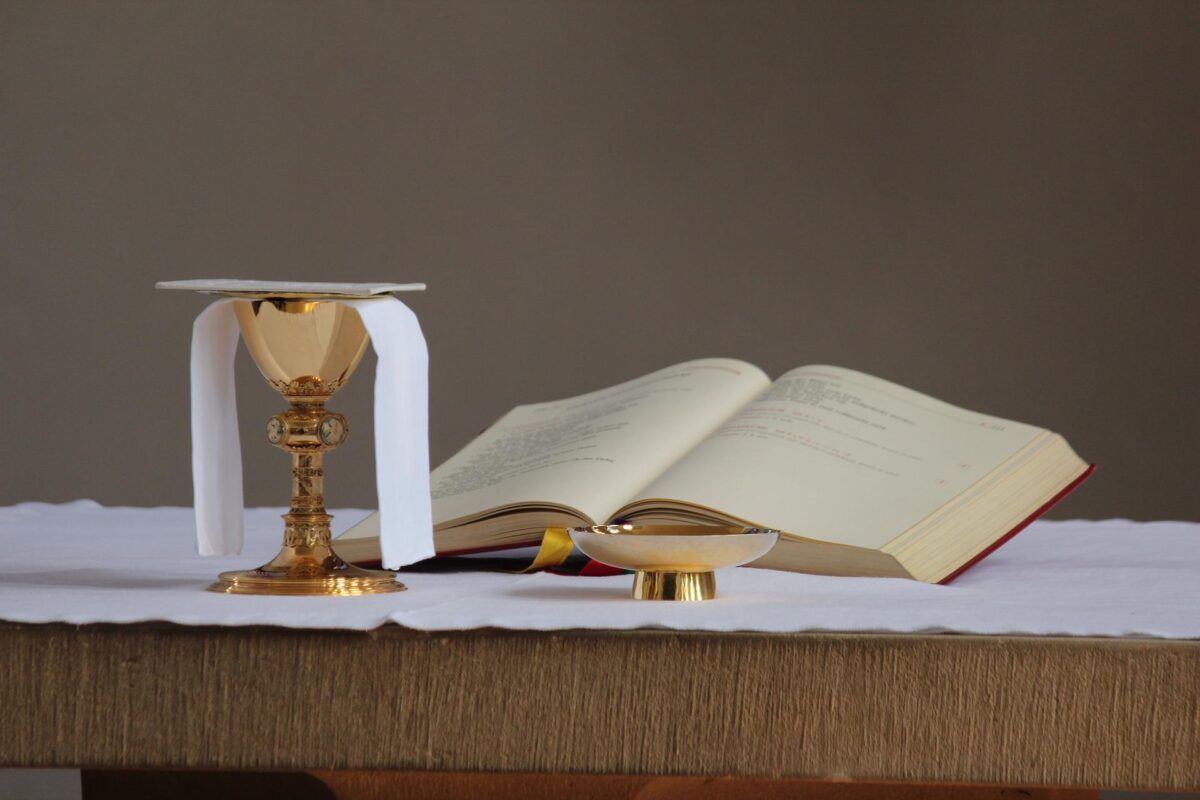
         On this solemnity we acknowledge and reflect on the real presence of Jesus Christ in the simple elements of the Eucharist – bread and wine – that are consecrated on the altar at every Mass. Not symbols, not representations of the body and blood of Christ but the real presence of Jesus.

         In today’s readings there is a beautiful thread woven between all of them about the bread and wine.

Starting in Genesis, we hear how Melchizedek used bread and wine to bless Abram after his great victories. The bread and wine were considered the first-fruits of the land, and were offered in sacrifice as a sign of recognition of God the Creator. Today, the priest will refer to the gifts of bread and wine as fruit of the earth.

The thread continues into the second reading as we hear Saint Paul, in a letter to the church in Corinth, recall the words Jesus used at the Last Supper.

We hear Jesus’s words as He broke the bread – His body – and then offered the cup of wine – His blood – and told the apostles that As often as you eat this bread and drink this cup, you proclaim the death of the Lord until He comes again.

We witness the power of those words each time the Mass is celebrated – those elements we first heard of in Genesis with Melchizedek and Abram and then Saint Paul wrote about, are the same elements we continue to see transformed on the altar.  While they may look like bread and wine on the outside – after their consecration by the priest their substance becomes the true presence of Christ.

A couple of years ago, a study was released that showed two-thirds of Catholics believed that the bread and wine used at Mass were not the real presence of Christ but rather symbols of His body and blood.

The survey goes on to reveal that most Catholics who do not believe the bread and wine are the true presence of Jesus Christ also do not know the Church’s teaching on transubstantiation. In the simplest of terms, transubstantiation is what happens when the priest prays the words of consecration and the substance of the bread and wine become the body and blood of Christ – yet still appear as just bread and wine.

Even more concerning from the survey, among those who know this central tenant of our faith, one in five reject the idea of the real presence of Jesus in the substance of the bread and wine.

Over the more than 2,000 years of our Church’s history, we often turn towards saints in matters like this to find understanding.

Here are just three examples about the true presence:

St. Thomas Aquinas, a doctor of the church, wrote that “The Eucharist is the sacrament of love: it signifies love, it produces love. The Eucharist is the consummation of the whole spiritual life.”

St. Cyril of Jerusalem boldly proclaimed that “Since Christ Himself has said, ‘This is My Body,’ who shall dare to doubt that it is His Body?”

The patron of our diocese, St. Augustine wrote that “What you see is the bread and the chalice; that is what your own eyes report to you. But what your faith obliges you to accept is that the bread is the body of Christ, and the chalice is the blood of Christ. This has been said very briefly, which may perhaps be sufficient for faith; yet faith does not desire instruction.”

In other words, these three saints, and there are others, tell us that the true presence of Jesus in the elements of bread and wine is a belief in the love that God the Father and his Son Jesus had for us – a love so strong that God the Father gave up His only Son for our sins. 

Then we hear Jesus’s own powerful words – This is my body.  

Finally, St. Augustine reminds us that faith in this matter does not require instruction – just belief. It just takes a little faith. Of course, faith is hard sometimes and needs to be reinvigorated – recharged.

So the bishops of the United States having seen the results of this survey decided there is a need for a Eucharistic Revival and that revival kicks off this weekend.

Over the next three years, you will see information which will begin on the diocesan level, followed by a year at the parish level and then a National Eucharistic Congress will be held in honor of the true presence of Jesus in the Eucharist. Then it will be time to become missionaries, sharing the gift of our Eucharistic Lord with others.

Even though that is a couple of years away, we can already begin evangelizing our own belief in the true presence of Christ in the Eucharist by sharing it with those we know who might be struggling with this aspect  of our faith. By the way, it is OK to struggle with our faith at times – it happens to me and many others – but we should also not persist in our disbelief.

Like Jesus said to Thomas when he appeared to the twelve, Blessed are those who have not seen and have believed. Jesus is talking to all of us right there.

It can be challenging to “prove” things like the true presence of Jesus in the Eucharist because as one of the great mysteries of our faith, we will never completely understand it until it is fully revealed by God the Father. Until then, it requires faith on our part.

We can build that faith by participating in the sacraments that are available to us such as receiving the Eucharist as often as we can – more than once per week if possible. Or maybe coming into the church here during the week and sitting with Jesus, who is in the tabernacle, to be close to his true presence in the Eucharist. We can also take any of these doubts into the sacrament of reconciliation to receive spiritual guidance on how to increase our faith in this great mystery. Then, just keep repeating those steps.

In Today’s gospel from St. Luke, this abundance and ability to receive and experience Jesus in the Eucharist is shown in the feeding of the five thousand. Initially we hear the apostles doubt about being able to feed this massive crowd.

Jesus removes that doubt by what he does next – a miracle.

Through His prayer and blessings, Jesus sanctifies the gifts of bread and fish. As they distribute the food to the crowd, there is more than enough to feed everyone and still have twelve wicker baskets of leftovers.

What a beautiful example of the abundance Christ gives us in the gift of the Eucharist. It is from the abundance of Christ’s love for us that we receive this precious gift – one we can receive in abundance ourselves.

Through our own encounters with Jesus in the Eucharist, we all have the opportunity to be changed profoundly.  

This change is possible because the power that is within the Most Precious Body and Blood of our Lord is His real presence.

No signs – no symbols – but truly Jesus’s body, blood, soul, and divinity.

Homily for Solemnity of the Most Holy Trinity (Year C)

By Deacon Richard Hay (First Homily after Ordination)

         I don’t know about all of you, but this feels just a little different to be standing behind the ambo today at this particular time during the Mass this morning.

This time of course, is where we would normally hear the homily from either Fr. Mike or Fr. Sebastian on today’s gospel and the other readings. Today that is not changing, there is still a homily to be delivered and shared before we move on to participating in the Liturgy of the Eucharist on this Solemnity of the Most Blessed Holy Trinity.

Today though, the new guy gets to share what is hopefully some insight for all of us.  

However, first there is a story to be told and it has been sitting up here in my head for the last four years or so just waiting for this day to arrive.

Here’s the inside scoop – this is not the first homily I have delivered from this ambo during a Mass at Sacred Heart. It’s true and some of you just might remember that day as well.

Shortly after being accepted as an aspirant for the Permanent Diaconate, I arrived here at the church for the Saturday Vigil Mass and was out in the narthex when Fr. Mike arrived – with barely any voice at all – full on laryngitis had left him literally speechless. He approached me and asked in a whisper if I would read his homily during the Mass. After the initial wave of anxiety passed, I answered yes and set to reading over the homily a few times.

Thankfully, everything went just fine and I didn’t do anything that got me kicked out of diaconate formation. I did know thought, that I would have a story to tell in a homily if God should bless me in the Sacrament of Holy Orders with ordination to the Permanent Diaconate. That blessing, as many of you can very clearly see with me standing here today before you vested a little differently, did arrive yesterday when Bishop Estevez ordained myself and six other men of our dioceses to the Permanent Diaconate for service in Christ’s church here in the Diocese of St. Augustine.

More on that later but as Fr. Rooney would often say, now a few thoughts about our scripture readings today.

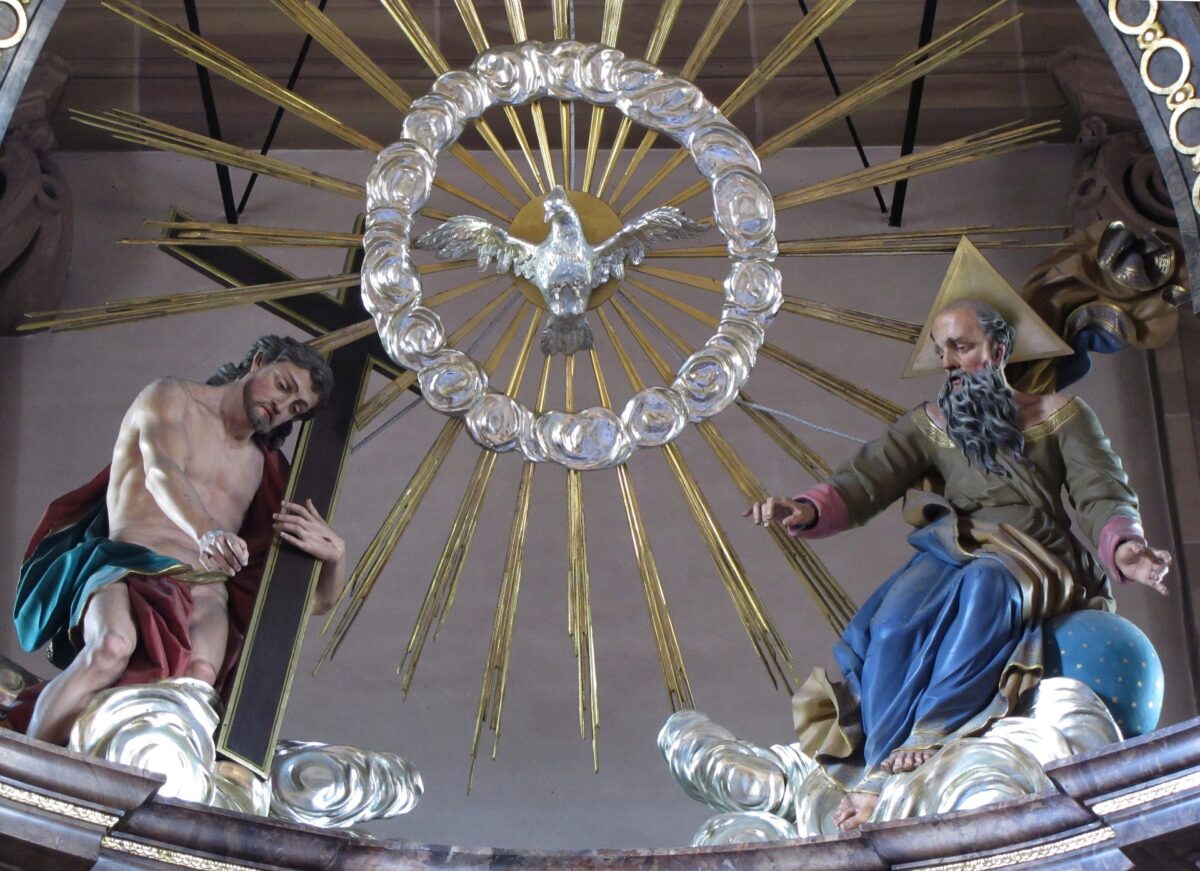
According to the catechism, The Most Blessed Holy Trinity is considered one of the central mysteries of our Christian faith and life. It is called a divine mystery because it can never be fully understood unless that mystery is revealed by God himself. However, we have plenty of examples throughout scriptures and church teachings that show us that part of this beautiful mystery of the Most Holy Trinity is all about love and joy. The love and joy which the Father, and the Son, and the Holy Spirit has for us. The love and joy that we see between the Father and the Son is the Holy Spirit. That same Holy Spirit whose coming we celebrated last Sunday at Pentecost, that inspired the apostles to be bold and speak the truth of Christ after His resurrection, and that same Spirit is with us all today – it is the foundation of all love in the Holy Trinity. Three persons yet one God.

Multiple times in scripture, God the Father proclaims his love for his son Jesus.

If I asked you to recite the New Testament verse at John 3:16, I suspect many of you know that it says, “For God so loved the world that he gave his only son, so that everyone who believes in him might not perish but have eternal life.”

Another time we heard of the Father’s love for his son Jesus was at Christ’s baptism in the Jordan River by John the Baptist. After Jesus rises out of the water, a voice is heard from heaven saying, “This is my beloved Son, with whom I am well pleased.”

Then, when Jesus took Peter, James, and John up the mountain, Jesus was transfigured, and we learn that “…his face shone like the sun and his clothes became white as light.”  and at this point we once again hear God the Father’s voice coming down from heaven saying, “This is my beloved Son, with whom I am well pleased…” just like at Jesus’s baptism but then he adds – “listen to him.”

Do we all listen to the Lord when he speaks to us? When he touches our heart with his unlimited love and joy, do we act on that love and joy or keep it to ourselves?

The love of our Lord and Savior Jesus Christ, the second person in our Most Holy Trinity, showed all of us the most ultimate sign of love – his sacrifice on the cross. When talking about being the true vine in John, Chapter 15, Jesus tells his disciples and us at the same time that – As the Father loves me, so I also love you. Remain in my love. If you keep my commandments, you will remain in my love, just as I have kept my Father’s commandments and remain in his love.

Right there we can see that Jesus’s relationship with his Father consists of the same type of love that Jesus asks us for – are we giving that level of love to Jesus each and every day in all that we do?

A little later in this same discourse about the vine and the branches, Jesus says that he has told us this so that his joy may be in us and that our joy may be complete.

Jesus wants nothing more than for us to carry his love and joy within us and then out into the world as we are the hands and feet of Christ in a society that desperately needs to see that love each and every day.

How do we keep that love fresh in us to carry out our task to proclaim Christ in the world? The sacraments can provide that beginning with the source and summit of our faith – the Holy Eucharist. We can begin by regularly receiving the Most Holy Body and Blood of Christ – his ultimate sacrifice of love which he gave us on the cross and we experience through the sacrifice on this altar at every Mass. When we receive the body, blood, soul, and divinity of Christ – when Jesus becomes part of us through the Eucharist – we can be filled to overflowing with his love and joy. It can fortify us to be sent forth from this place and allows us to head out into the world to proclaim the good news of his life, death, and resurrection – proclaiming it with love and joy for all to see through our actions – and sometimes you can use words too.

This brings us to the Holy Spirit, the Advocate, the Paraclete as Jesus described him just before ascending to the Father in heaven. Jesus told the apostles that the Holy Spirit that the Father will send in my name – he will teach you everything and remind you of all that I told you.

That means when we carry the Holy Spirit within us, which we received at our baptisms and again when we were sealed in the Holy Spirit at our confirmations, we can carry everything that Christ told us while he was on earth. All of the love, all of the joy that Christ feels for us is reinforced and strengthened through the Holy Spirit.

We heard proof of that strengthening of the Holy Spirit throughout the Easter Season as we read the Acts of the Apostles and saw how the apostles and other disciples of Christ were emboldened to speak the truth of God at all times and in all things. They were no longer scared of consequences for proclaiming the good news – they just knew that they must make this news known to the ends of the earth.

Are we carrying that strengthened and reinforced spirit within us as we proclaim the good news of Jesus to those in the world? Do we let the spirit move us and provide us with the words we need to speak?

As human beings, we long to be loved and what greater love is their than to be loved unconditionally by our God. It is unconditional because we do not have to do one thing to earn the love of God – it is there for us at all times – we just have to accept it and love God in return with all our hearts, all our souls, and with all our minds.

I would like to take just one more moment as I conclude and share something from the commentary I was studying while preparing this homily – it is a beautiful wrap-up on what the Most Blessed Holy Trinity is all about. The author writes:

We need God’s help to love others as Jesus loved us. To produce the fruits of love, we must remain on the vine and be pruned by the Father. Put differently, if we are to love others as God does, we need to remain and grow in communion with Jesus, through such things as prayer, the sacraments, and works of penance. Through these spiritual practices, we open ourselves to God’s action in us whereby we increasingly die to our own sinfulness and become conformed to the Father’s will. Thus, we will come to joyfully experience the Father’s love and be able to love others as he calls us to do.

So our mission this week is to carry the love that is shown to us in the Most Blessed Holy Trinity out into the world and impact the life of just one person. Share with them the love of God through one of the seven works of corporal mercy such as feeding the hungry, giving drink to the thirsty, clothing the naked, sheltering the homeless, and visiting the sick and imprisoned.

May the love we see in the Most Blessed Holy Trinity, embolden each one of us to change the world in one small way this week.

Today this, my first Mass as deacon at Sacred Heart, is one of thanksgiving for my call to the diaconate and my ordination yesterday. While I am the person standing up here in these vestments, there were all kinds of people involved over the six years of my formation and my years of discernment. Included in this list of people, there are many who might never know their impact and my resulting ordination to this ministry of service. Each and every one of them deserves thanks and they will forever be in my prayers.

While I can’t stand up here and thank everyone else individually and would likely miss so many people, allow me to say a simple thank you to Margo for all her care and support throughout this process, the long nights and weekends of me studying, reading and attending classes in these six years of formation. She has been my rock in our 38 years together – I love you Margo. Someone else attending this Mass today is Deacon Paul Testa from Mary Queen of Heaven who has been my mentor over these last three years and is now someone I can call a lifelong friend and now a brother deacon. Thanks Deacon Paul.

Here at Sacred Heart, so many of you have been praying for and encouraging me as I travelled on this journey – including some very intense prayer for me to be assigned here at Sacred Heart. We now know this is where Bishop Estevez has decided to allow me to begin my ministry as a deacon. Thank you all so very much – you all will continue to be in my prayers.

By the way, I know it isn’t a contest or anything like that, but Sacred Heart attendees at the Ordination Mass yesterday easily outnumbered other parishes by a factor of at least two – maybe three. Thanks for making that effort to be part of a very blessed day for me, my family, and of course our parish.

Finally – to Fr. Mike and Fr. Sebastian – your pastoral and liturgical mentorship has been a blessing. I have enjoyed learning from both of you and I look forward to continuing those relationships in service to the Sacred Heart community.

Deacons have a unique role in the church because we have one foot in the secular world with our lives involving family, children, and our careers and then we have another foot here in the sacred of our church because of our ordination which configures us to Christ as his servants to all the people of God.

It is a role I cherish and am blessed to have received. I look forward to sharing this journey with all of you.

Please continue to pray for all of us here at Sacred Heart that we are people who carry the love of Christ from within this sacred place and out into the world.

Thanks.

Weekly Scriptural Reflection for 18 November 2014

And when you turn to the right or when you turn to the left,

your ears shall hear a word behind you, saying,

“This is the way; walk in it.”

Isaiah 30, Verse 21

What peace this verse brings to my heart. It reminds me that no matter where I go, what direction I go in, God is always with me. If I choose to listen to him, he will always direct me on the path that I need to travel.

He always has my best interests at heart and, even though sometimes things may not unfold the way that I think they should, I can fully trust in God to be leading me where I need to go. He is my loving Father, my Counsellor, my Guide.

Amen!

Blessings,

Margo
18 November 2014

See the video reflection that accompanies this post – Isaiah 30:21

Don’t forget to subscribe for email alerts and to follow us on Facebook and Twitter.

Weekly Scriptural Reflection for 20 October 2014

For by grace you have been saved through faith,

and this is not your own doing;

it is the gift of God, not the result of works,

so that no one may boast.

Ephesians 2, Verses 8-9

 
It is made very clear in these two short verses exactly how we have been saved and what this means for us. We are saved by having faith, trusting in God and he, through his grace saves us. He gives us this grace freely as a gift. We don’t have to spend our lives working for it. We don’t have to labor in order to get it. We don’t have to rack up a mountain of good works to prove ourselves worthy of receiving God’s grace.

There is a very special reason behind this. God knows us mortals well. If we had to work to get grace we would then probably shout from the hill tops how grand we were. So to help us remain humble, and because he loves us so much, God simply pours his grace all over us and so we are saved.

Thank you God!!

Blessings,

Margo
20 October 2014

See the video reflection that accompanies this post – Ephesians 2:8-9

Don’t forget to subscribe for email alerts and to follow us on Facebook and Twitter.

Weekly Scriptural Reflection for 06 October 2014

You hem me in, behind and before, and lay your hand upon me.

Such knowledge is too wonderful for me;

it is so high that I cannot attain it.

Psalms 139, Verses 5-6

 
The imagery in these two verses is very clear and quite amazing. As I read the first verse I pictured God carefully yet relentlessly herding me along as a cowboy would do with a wild horse. Then as God corrals me, blocking my escape in the front and from behind, he gently lays his hand on me and I am tamed in his love.

The second verse expresses how I can hardly believe that God would do this for me. It is beyond my wildest dreams, beyond my human comprehension, that he would care enough about me to seek me and save me, to bring me into his arms. Alleluia!

Blessings,

Margo
06 October 2014

See the video reflection that accompanies this post – Psalms 139:5-6

Don’t forget to subscribe for email alerts and to follow us on Facebook and Twitter.

Weekly Scriptural Reflection for 24 September 2014

For the mountains may depart and the hills be removed,

but my steadfast love shall not depart from you,

and my covenant of peace shall not be removed,

says the Lord, who has compassion on you.

Isaiah 54, Verse 10

 
Here the prophet Isaiah is reaffirming just how steadfast the love of the Lord is for his people, for us. He uses the image of mountains disappearing and hills being taken away, in other words chaotic and seemingly impossible events, to show just how strong God’s love for us is. No matter what disasters may befall us, no matter what tragedies may surround us, God’s love is always present, an ever-present source of strength and support in difficult times.

And right alongside God’s love is his peace which he has promised through covenant to us, his children. He has such compassion for and mercy on us that his love and peace will never be removed, no matter what. What an awesome God!

Blessings,

Margo
24 September 2014

See the video reflection that accompanies this post – Isaiah 54:10

Don’t forget to subscribe for email alerts and to follow us on Facebook and Twitter.

Weekly Scriptural Reflection for 16 September 2014

Praise the Lord!

Praise the name of the Lord; give praise, O servants of the Lord,

you that stand in the house of the Lord, in the courts of the house of our God.

Praise the Lord, for the Lord is good; sing to his name, for he is gracious.

Psalms 135, Verses 1-36

 
I think that today in most main stream Christian churches we have gotten away from “praising” the Lord. Most of us attend church, go to “the house of the Lord”, just once a week – maybe twice a week. We attend services, say our prayers, and sing a few songs. But do we really “praise” God? Do we lift our voices joyfully, exultantly, enthusiastically? These verses exhort us to praise the Lord when we are in his house, to “sing to his name”. They remind us that we should do this because the Lord is good and gracious.

If I really consider the might of the Lord, if I truly consider who he is and what he has done for humankind, for me, I should be singing His praises from the moment I awake to the moment I fall back asleep, every day. Hallelujah!! God is good!

Blessings,

Margo
16 September 2014

See the video reflection that accompanies this post – Psalms 135:1-3

Don’t forget to subscribe for email alerts and to follow us on Facebook and Twitter.

Weekly Scriptural Reflection for 08 September 2014

They who have my commandments and keep them are those who love me;

and those who love me will be loved by my Father,

and I will love them and reveal myself to them.

Romans 8, Verse 26

 
Because we are human and consequently imperfect, we need help on our spiritual journey. In our humanity, we are weak. Jesus knew this and sent us the Spirit to help us and guide us. Paul states that because of our weakness and imperfection “we do not know how to pray as we ought.”

And so the Spirit intercedes on our behalf, and not just in any ordinary fashion. Spirit intercedes “with sighs too deep for words”. Have you ever felt so full of emotion that you couldn’t speak? Were you ever so emotional that all you could manage were deep sighs? That is how Spirit intercedes on our behalf to God. Amen!

Blessings,

Margo
08 September 2014

See the video reflection that accompanies this post – Romans 8:26

Don’t forget to subscribe for email alerts and to follow us on Facebook and Twitter.

Weekly Scriptural Reflection for 18 August 2014

They who have my commandments and keep them are those who love me;

and those who love me will be loved by my Father,

and I will love them and reveal myself to them.

John 14, Verse 21

 
Jesus is very clear as to how we should show our love for him. We are to keep his commandments. And he is equally clear in his message of love, which he continuously shares throughout his ministry. In keeping his commandments we show our love for him, and in doing this we will be loved by the Father.

But, as the last words of this verse indicate, we see that the circle of love is yet to be complete. We keep Jesus’ commandments, we show that we love him, in return we are loved by the Father ….. then Jesus loves us and reveals himself to us. What a beautiful vision of total, fulfilling, all-encompassing love!

Blessings,

Margo
18 August 2014

See the video reflection that accompanies this post – John 14:21

Don’t forget to subscribe for email alerts and to follow us on Facebook and Twitter.

Weekly Scriptural Reflection for 08 August 2014

And God is able to provide you with every blessing in abundance,

so that by always having enough of everything,

you may share abundantly in every good work.

Corinthians 9, Verse 8

 
Not only does God provide us with “every blessing”, he does so “in abundance”. The word abundance makes me think of ripe peaches and big fluffy pillows and comforters, and women in the third trimester of their pregnancy. It suggests fullness. And that is how our God takes care of us – fully, completely.

What we need to be aware of is that we have our part to play in this “fullness”, this provision. As we accept the gifts and blessings that God showers upon us, let us open our hearts and our minds to those still in need. Let us remember to “share abundantly” and be as generous with others as God is with us.

Blessings,

Margo
07 August 2014

See the video reflection that accompanies this post – Corinthians 9:8

Don’t forget to subscribe for email alerts and to follow us on Facebook and Twitter.