
By Deacon Richard Hay
“Persistence and Small Acts in Faith”
Over the last few weeks, the gospel readings on Sunday have had a common thread – that small things can become big blessings.
We heard that the Kingdom of Heaven is like a mustard seed – the smallest of seeds that becomes the biggest of plants; we followed along as Jesus took just five loaves of bread and two fish to feed a crowd of more than 5,000; and last week we heard how Peter took a small step of faith towards Jesus on the water and although he became afraid and started to sink, he still trusted that the Lord would reach out to him in his moment of need.
Author Robert Collier once wrote that “Success is the sum of small efforts, repeated day-in and day-out.” Our life of faith is like that – it takes small acts of faith strung together in perseverance.
St. Monica is a beloved saint because so many people recognize themselves in her story of persistence. For nearly 30 years she prayed for her son Augustine’s conversion and saw little evidence that anything was changing. Yet she never stopped bringing him before the Lord. In the end, Augustine became one of the greatest saints in the history of the Church. St. Monica reminds us that God’s silence is not the same thing as God’s absence. That same lesson of perseverance and taking small steps in faith lies at the heart of today’s Gospel.
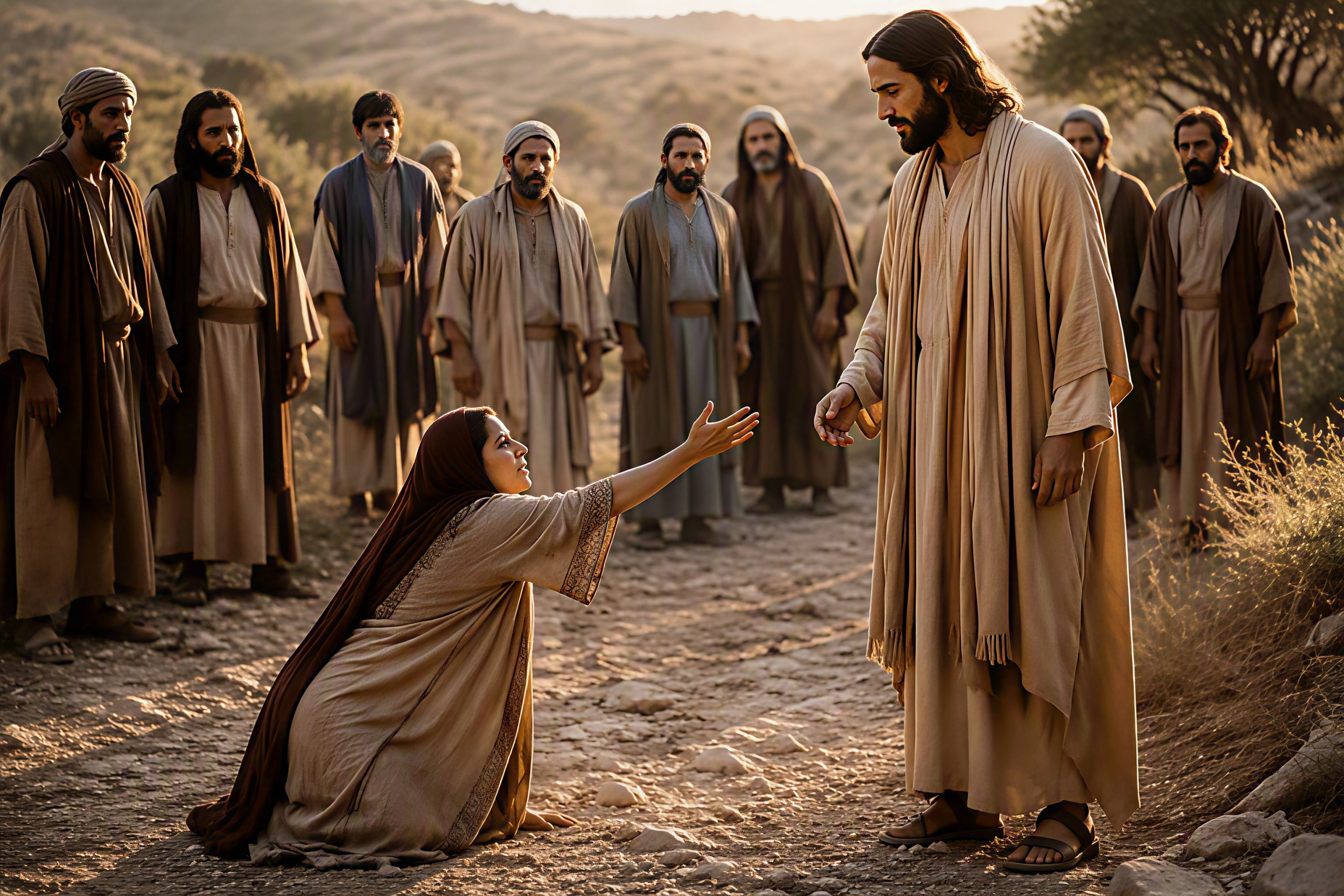
At first glance, this is one of those Gospel passages that can make us uncomfortable. A desperate mother approaches Jesus. Her daughter is suffering terribly, and she comes pleading for mercy. Jesus is silent. The disciples are annoyed. Then Jesus says that He was sent only to the lost sheep of the house of Israel. The conversation seems to become even more uncomfortable. If we read the passage too quickly, we can walk away wondering why Jesus appears so distant from a woman who is clearly in pain.
What Jesus is doing here is revealing something not only about this woman, but about His mission, and about the nature of faith.
When Jesus says that He was sent to the lost sheep of Israel, He is reminding us that God’s plan of salvation unfolds throughout history. The Messiah comes first to the people to whom the promises were given. God had chosen Israel, formed Israel, and prepared Israel for centuries. Jesus is the fulfillment of everything God had promised through the Law and the Prophets. His mission begins there because God is faithful to His covenant.
The woman who approaches Jesus is a Canaanite, a Gentile, someone outside the covenant people. She represents all those who would later hear the good news of the Gospel in all the nations and the future Church – she represents us.
What is remarkable is not her background but her faith. She comes to Jesus with confident persistence. She addresses Him as Lord and Son of David. She believes He has the power to heal her daughter. Perhaps most importantly, she refuses to be discouraged. Even when He seems silent, she continues to approach Jesus. Even when the disciples want her gone, she continues to seek Jesus. Even when she encounters what seems to be rejection, she does not turn away. She simply kneels before Jesus and says, “Lord, help me.”
That is why this woman’s prayer feels so familiar. At some point in life, we all find ourselves before God carrying concerns that are bigger than us. It may be a child who is struggling, a marriage under strain, a loved one who is ill, a grief that will not go away, or a burden that has left us feeling exhausted and powerless. The details differ from person to person, but the prayer is the same – “Lord, help me.”
If we’re honest, what makes those moments more difficult is that sometimes it does seem that God is silent. We pray and nothing appears to change. We ask and the answer does not seem to come. We seek and the path forward remains unclear. The temptation in those moments is to assume that God is not listening to us.
The Canaanite woman teaches us otherwise. She shows us that faith is not merely believing when prayers are answered immediately. Faith is continuing to trust even when the answer is delayed. It is continuing to seek Christ even when we do not understand what He is doing. Her persistence is not stubbornness; it is confidence that the mercy of God is greater than whatever obstacle stands before her.
That confidence eventually draws from Jesus an extraordinary statement – “O woman, great is your faith.”
Jesus does not say this to one of the religious leaders or to one of the disciples. He says it to a foreign woman, someone outside of the covenant, who comes to Him with nothing except faith and trust. Her faith is the bridge across barriers that might have separated her from Jesus.
This passage also points forward to the Great Commission at the end of Matthew’s Gospel. The same Jesus who says here that His mission begins with Israel will later send His apostles to make disciples of all nations. This encounter is a glimpse of where the story is heading. God’s saving work begins with Israel, but it is destined for the whole world. The mercy revealed in Christ cannot be contained within one nation or one people. It is meant for everyone.
The disciples see this woman as a nuisance and want to send her away. Jesus sees her faith and welcomes her. Our parish should hear that challenge and ensure that when people come searching for Christ at Sacred Heart, that they encounter open doors and no barriers. We should make sure we continue to be a community that is ready to receive them, and not one that expects them to prove themselves before they belong. As a parish we should always be attentive to those on the margins, those carrying wounds, those who have been away from the Church, those who are searching but unsure where to begin.
The Gospel reminds us that the Church exists because the mission of Jesus continues. We are not simply caretakers. We are part of the ongoing mission of Christ to draw all people to Himself. Just as this Canaanite woman found mercy when she came seeking the Lord, Sacred Heart should be a place where people encounter that same mercy.
And finally, there is encouragement here for anyone who is carrying the concerns of others in prayer. The woman comes to Jesus not for herself but for her daughter and intercedes on her behalf. I suspect many of us understand exactly what that feels like. You pray for a child who has drifted from faith. You pray for healing, for reconciliation, for freedom from addiction, for a return to the sacraments. You pray for days, months and years and wonder if your prayers are accomplishing anything at all.
This Gospel offers a quiet but powerful encouragement: do not stop bringing those prayers to Christ. The woman never sees the whole picture. She simply keeps asking, keeps trusting, keeps placing her daughter before the Lord. In the end, she discovers that what appeared to be silence was not indifference, and what appeared to be rejection was not abandonment. The Lord had been at work all along and continues to do so in our lives today.
As we come to the altar today, perhaps each of us could bring with us the simple prayer of the Canaanite woman: “Lord, help me.” It is not a sophisticated prayer, but it is an honest one. It is the prayer of a heart that knows its needs God and trusts in His mercy. May we all have the courage to pray it, the persistence to keep praying it, and the faith to believe that even when we cannot see what God is doing, He is already doing it according to His will.
